

TL;DR: Repeat revenue comes from running two lanes: Amazon’s native tools such as Manage Your Customer Engagement for launches and reactivation, and an owned email list built through legitimate opt-ins like warranty registration, avoiding reviews or discounts tied to the Amazon purchase. Segment by buyer economics such as expected reorder window, and check sell-through before sending any campaign.
Amazon seller email marketing is not about scraping buyer addresses or trying to pull Amazon customers into a channel you do not control. The profitable version is cleaner: use Amazon’s approved tools inside the marketplace, build owned audience paths where allowed, and connect email strategy to inventory, margin, and repeat purchase economics.
Table of Contents
- The real constraint: Amazon owns the buyer relationship
- Use Amazon’s native email tools for marketplace objectives
- Build owned email without violating Amazon rules
- Segment by buyer economics, not newsletter themes
- Make email part of inventory planning
- Coordinate email with PPC, launches, and ranking goals
- What to measure beyond open rates
- Common mistakes that cost sellers money
- A 30-day implementation plan
- Frequently Asked Questions
That distinction matters because Amazon sellers sit in a strange position. You can generate large order volume without owning the customer relationship. Amazon controls the checkout, the buyer experience, and most post-purchase communication. That makes marketplace revenue efficient, but it also creates a weak spot: repeat revenue depends heavily on Amazon visibility, PPC spend, ranking, Subscribe & Save, and algorithmic demand rather than a direct relationship with buyers.
For 7 and 8 figure brands, email should not be treated as a side channel run by a generic newsletter calendar. It should be an operating system for retention. The goal is to increase repeat purchase rate, improve launch velocity, reduce dependency on paid clicks, and protect margin when ad costs rise.
The real constraint: Amazon owns the buyer relationship
Amazon’s communication rules are strict for a reason. Sellers cannot use buyer-seller messaging to send marketing emails, request external purchases, or push customers away from Amazon. Amazon’s own Communication Guidelines make that clear: permitted messages must be necessary to complete an order or respond to a buyer service issue.
That means a seller cannot simply export Amazon buyers into Klaviyo, send them a 20 percent off DTC offer, and call it retention. That creates account risk. It also misses the strategic point.
Your Amazon email strategy has 2 lanes:
- Marketplace-native email and engagement tools that Amazon allows.
- Owned audience capture outside Amazon, built through packaging, content, warranties, loyalty, quizzes, communities, and your DTC site.
The brands that win use both lanes without blurring compliance lines. They do not chase gray-hat tactics for a short-term bump. They build a retention asset that compounds.
Use Amazon’s native email tools for marketplace objectives
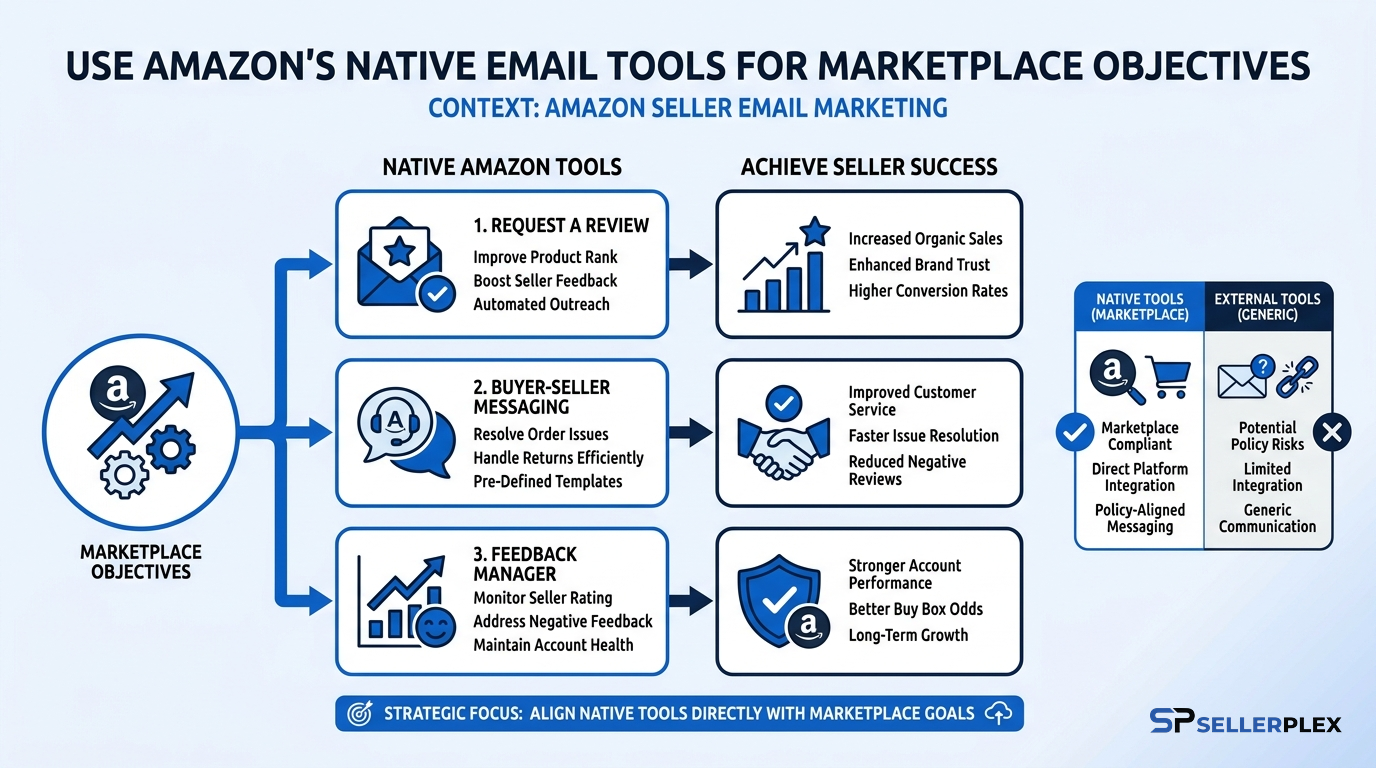
Amazon has given brands more controlled ways to reach followers and customer segments, especially through tools available to eligible brands. The best-known example is Manage Your Customer Engagement, which lets registered brands send campaigns to shoppers who follow the brand on Amazon.
Amazon has also expanded audience targeting features for eligible sellers. The capabilities vary by marketplace and account eligibility, so you need to confirm what is available inside your own Seller Central account rather than assuming every feature is live for every brand.
Native Amazon email tools are useful for:
- New product launches
- Seasonal promotions
- Re-engaging brand followers
- Supporting repeat purchase for replenishable items
- Increasing awareness across a catalog
They are not a full replacement for owned email. You typically have limited creative control, limited segmentation, and limited portability. The upside is compliance and marketplace relevance. The customer stays inside the Amazon environment, which is exactly what Amazon wants.
Where native Amazon email fits in the funnel
Think of Amazon-native email as a launch and reactivation layer, not your whole retention engine.
For example, a supplement brand with 40,000 monthly Amazon orders might use Amazon’s audience tools to support a new flavor launch. The campaign can drive initial visibility to people already familiar with the brand. At the same time, the brand’s DTC email list can educate customers on ingredient use cases, subscription options, and bundle logic outside Amazon.
Those 2 campaigns should not use identical messaging. On Amazon, the focus is fast product discovery and conversion. In owned email, the focus is education, preference building, and lifetime value.
80+ in-house specialists across PPC, supply chain, account management and content.
Build owned email without violating Amazon rules
The safest way to build owned email from an Amazon-heavy business is to create legitimate reasons for customers and prospects to opt in outside Amazon.
Packaging inserts are one route, but they must be handled carefully. Do not offer incentives that require a positive Amazon review. Do not direct customers to leave Amazon for the same transaction. Do not use manipulative language. Amazon’s Customer Reviews policy is especially strict around review manipulation.
Better opt-in angles include:
- Product registration for warranty coverage
- Usage guides or setup videos
- Replenishment reminders
- Recipe books or care instructions
- Fit guides, ingredient guides, or compatibility checkers
- VIP launch access for future products
- Loyalty programs on your DTC site
The opt-in has to be valuable enough that a customer would want it even without a discount. A kitchen appliance brand can offer maintenance reminders and recipe content. A pet brand can offer portion guidance by breed and weight. A beauty brand can offer routine planning based on skin type. These are real customer needs, not thinly disguised list-building tricks.
If your Amazon listings are weak, do not expect email to rescue the economics. Email captures demand after trust has been established. Strong conversion assets still matter. This is where Amazon content optimization and brand storytelling carry weight, because your listing, A+ content, and Storefront set expectations before someone ever joins your list. For a deeper breakdown, SellerPlex’s guide to Amazon product listing optimization explains how stronger detail pages improve conversion before you add more traffic.
Segment by buyer economics, not newsletter themes
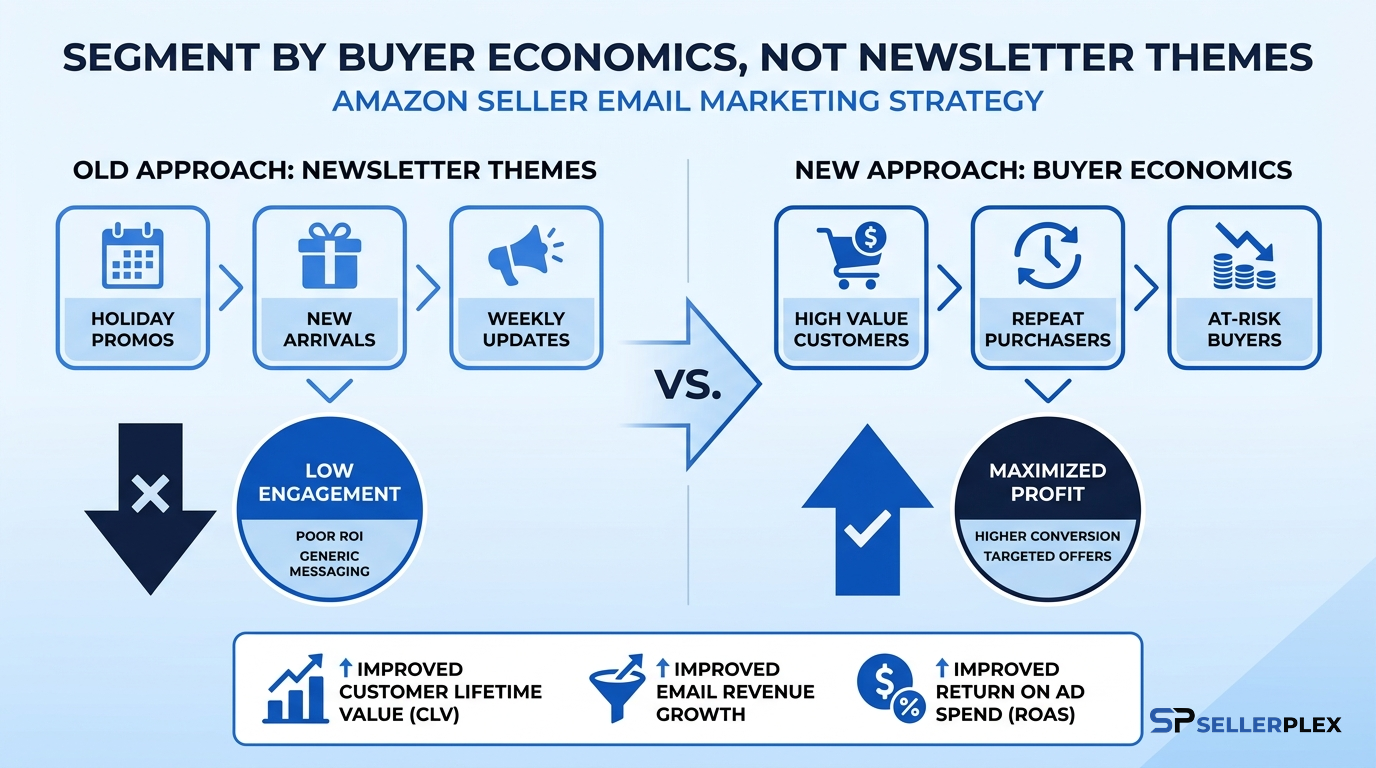
Most Amazon sellers underuse segmentation because they think in campaigns instead of economics. A monthly newsletter to everyone is easy to run, but it rarely changes margin.
Useful segmentation starts with commercial questions:
- Which products have a predictable replenishment cycle?
- Which SKUs lead to higher-margin bundles?
- Which buyers are likely to need education before repurchase?
- Which customers bought an entry-level product and should move to a premium variant?
- Which categories are sensitive to seasonality or stock availability?
A brand selling consumables might segment by reorder window. If the average jar lasts 32 days, the email flow should start before day 32, not 2 months later. A brand selling accessories might segment by parent product. If a customer bought a camera mount, the next message should not promote an unrelated SKU. It should show compatible add-ons and use cases.
For higher-ticket or complex products, email should reduce uncertainty. That means setup content, troubleshooting, warranty clarity, and comparison guidance. The sale after the sale often determines review quality, return rate, and future purchase behavior.
A practical segmentation model
Use 4 working segments before you overcomplicate the stack:
| Segment | Trigger | Primary goal | Example email angle |
|---|---|---|---|
| New subscriber | Opt-in through guide, warranty, quiz, or DTC offer | Build trust and collect preference data | How to get the best result from the product category |
| Recent buyer | Confirmed purchase or registration | Reduce returns and improve usage | Setup guide, care sequence, product education |
| Replenishment candidate | Expected reorder window approaching | Drive repeat purchase | Reminder, bundle suggestion, subscription option |
| Cross-sell candidate | Bought SKU with logical companion product | Increase AOV and LTV | Compatibility guide or routine builder |
This model is simple enough to execute, but it ties every flow to revenue or risk reduction.
Make email part of inventory planning
Email can create demand faster than operations can fulfill it. That is good when inventory is healthy. It is expensive when stock is thin.
Before promoting any Amazon ASIN or DTC bundle, check:
- Current sell-through rate
- Weeks of cover
- FBA inventory by marketplace
- Inbound shipment timing
- Gross margin after promotion
- PPC and organic ranking objectives
If a SKU has 2 weeks of cover and inbound inventory is delayed, pushing an email campaign can trigger a stockout. On Amazon, that can damage ranking momentum and force you to spend more on PPC after inventory returns. If a SKU is overstocked, email can be a margin recovery lever, especially when paired with bundles or limited-time DTC offers.
This is why retention should not sit in a silo. The email calendar needs input from account management, PPC, supply chain, and content. A campaign that looks great in an email dashboard can still hurt the business if it drains the wrong inventory or sends traffic to a weak listing.
SellerPlex sees this issue most often in brands that treat Amazon and DTC as separate teams. The Amazon team worries about ranking and stockouts. The DTC team worries about list growth and revenue per recipient. Finance worries about margin. Nobody owns the full operating picture.
If stock availability is already creating constraints, fix that before adding more promotional pressure. Strong Amazon supply chain management gives retention campaigns room to work. The same principle shows up in Amazon inventory planning, where fewer stockouts and higher margin often come from better timing, not more aggressive promotion.
Turn Email Into Repeat Revenue
Build email flows that support Amazon growth, DTC retention, and cleaner customer journeys without creating operational drag.
Coordinate email with PPC, launches, and ranking goals
Email can reduce the pressure on paid media, but only if it is coordinated with your marketplace strategy.
Consider a brand launching a new variation under an established parent ASIN. PPC can create initial search visibility. Amazon-native email can alert brand followers. Owned email can educate existing DTC customers or subscribers who have shown interest in the category. The listing content has to be ready before any of that traffic arrives.
If each channel runs independently, you get wasted spend. PPC sends traffic before the detail page is persuasive. Email promotes a product with thin reviews. Inventory runs low during launch week. The brand sees revenue, but the blended margin tells a different story.
The better approach is to plan from the target economics backward:
- Define the launch target: units sold, gross margin, review velocity, ranking support, or DTC list activation.
- Confirm inventory and replenishment timing.
- Prepare listing content, creative, Storefront paths, and DTC landing pages.
- Sequence Amazon-native email, owned email, and PPC around the same window.
- Measure contribution by channel, not just total revenue.
For brands with rising ad costs, this coordination is especially important. SellerPlex has covered the economics of paid traffic in its guide to Amazon PPC cost. Email will not replace PPC, but it can improve the blended cost of demand when it supports the same commercial objective.
What to measure beyond open rates
Open rates are weak decision metrics. Apple Mail Privacy Protection and other inbox changes have made opens less reliable as a signal. Treat opens as directional at best. Revenue, margin, repeat purchase behavior, and operational impact matter more.
Track these instead:
- Revenue per recipient
- Click-to-purchase rate
- Repeat purchase rate by cohort
- Reorder interval
- Unsubscribe and spam complaint rate
- Bundle attach rate
- Contribution margin after discounts and shipping
- Incremental lift during launch windows
- Stockout risk created by campaigns
Owned email platforms can report revenue attribution, but attribution windows can overstate impact. A customer who clicked an email and bought later may have been influenced by Amazon search, ads, or Subscribe & Save behavior too. Use platform reports, but do not let them be the only source of truth.
A practical scorecard for a mature Amazon seller should combine:
- Email platform data
- Seller Central sales data
- Amazon Ads performance
- DTC analytics
- Inventory reports
- Gross margin by SKU
This is where operational discipline beats channel activity. Email is not profitable because it sends messages. It is profitable when it changes customer behavior without breaking inventory, margin, or compliance.
Common mistakes that cost sellers money
The biggest email mistakes are usually operational, not creative.
Treating Amazon customers as owned contacts
Buying lists, scraping data, or using Amazon order information for unauthorized marketing creates compliance risk. It also weakens your brand. Build opt-ins the right way.
Discounting too early
A 15 percent discount can train customers to wait for offers. For replenishable products, education, bundles, subscriptions, and timing often outperform blanket discounts.
Sending traffic to weak pages
If your DTC landing page has unclear messaging or your Amazon listing has poor creative, email will expose that weakness. Review the page before sending traffic. The same logic applies to Amazon detail pages. If conversion rate is low, invest in listing optimization that improves buying confidence.
Ignoring SKU-level margin
Revenue from email looks good until you account for discounts, fulfillment costs, ad overlap, and refunds. Segment offers by margin profile.
Running retention without an owner
Email touches content, customer experience, PPC, operations, and finance. If nobody owns the whole system, it becomes a calendar instead of a profit lever.
A 30-day implementation plan
You do not need a 6-month transformation to make progress. A focused 30-day sprint can identify the biggest retention gains and remove obvious risk.
Week 1: Map the customer paths
Document every legal opt-in path you currently have: DTC checkout, warranty registration, quiz, packaging insert, Amazon followers, Storefront, social, post-purchase content, and customer support. Identify which paths are compliant, which are weak, and which need to be removed.
Week 2: Pick 2 revenue flows
Choose 1 replenishment flow and 1 cross-sell or education flow. Do not build 12 automations at once. Pick the flows tied to the clearest margin opportunity.
For a consumables brand, that might be a reorder reminder and a bundle introduction. For a durable goods brand, it might be setup education and accessory cross-sell.
Week 3: Connect content to conversion
Audit the destination pages. If email sends users to Amazon, review the listing title, images, A+ content, reviews, and variation structure. If email sends users to DTC, review landing page speed, offer clarity, product education, shipping thresholds, and checkout friction.
If your Amazon account already has multiple moving parts, a stronger Amazon account management process can keep launches, content, inventory, and retention aligned.
Week 4: Launch, measure, and cut waste
Launch the 2 flows with clean tracking. Review results after enough volume to matter. Keep the flows that improve repeat revenue or reduce support burden. Cut or rewrite anything that creates unsubscribes, low conversion, or operational strain.
A simple 30-day sprint should leave you with 3 outputs: a compliant opt-in map, 2 live revenue flows, and a scorecard that connects email to SKU-level economics.
Frequently Asked Questions
Can Amazon sellers email their customers directly?
Amazon sellers can only message buyers through approved Amazon systems for permitted purposes, such as completing an order or responding to customer service issues. Marketing to Amazon buyers outside those rules can create account risk.
What is the best email strategy for Amazon sellers?
The best strategy combines Amazon-approved engagement tools with owned email capture outside Amazon. Use marketplace-native tools for launches and follower engagement, then use owned email for education, replenishment, cross-sell, and DTC retention.
Can packaging inserts collect email addresses?
Packaging inserts can invite customers to opt in for legitimate value, such as warranty registration, setup guidance, or product education. They should not manipulate reviews, require positive feedback, or pressure customers to leave Amazon for the same purchase.
Should Amazon sellers use discounts in email campaigns?
Discounts can work, but they should be tied to margin and customer behavior. Replenishment reminders, bundles, subscriptions, and education often protect margin better than blanket discounts.
How should email support an Amazon product launch?
Email should be coordinated with inventory, listing readiness, PPC, and launch goals. Amazon-native email can alert marketplace followers, while owned email can educate existing subscribers and drive qualified demand into the launch window.
Where to start
Amazon seller email marketing works when it respects Amazon’s rules and connects to the operating reality of the business. Start with compliance, then build opt-in paths that customers actually value. From there, prioritize the flows that improve repeat purchase, reduce support issues, or support launches without creating inventory problems.
If your brand is already doing 7 or 8 figures on Amazon, the upside is not another newsletter. The upside is a retention system that connects content, PPC, account management, inventory, and DTC growth into one commercial plan.
SellerPlex helps Amazon brands build that kind of operating system. If you want support turning email, content, and marketplace execution into measurable repeat revenue, start with a focused review of your Amazon content and customer journey.
Ready to Grow Your Amazon Business?
Book a free strategy session with our Amazon and e-commerce specialists. No obligations, just actionable insights.
Day-to-day Seller Central operations handled for you: catalog health, cases, compliance and buyer messages.
Want more of this in your Google results? Add SellerPlex as a preferred source.