
Amazon Inventory Management Tips: A Practical Guide to Fewer Stockouts and Higher Margin

TL;DR: Fewer stockouts and higher margin come from a weekly system: forecast demand by SKU, calculate true lead time from production to Amazon receiving, and set reorder points from average daily sales times lead time plus safety stock. Split inventory across FBA, a 3PL, and your supplier, then review a weekly exception report of stockouts, overstock, and delayed shipments.
Introduction
If you sell on Amazon, inventory mistakes get expensive fast. A stockout can kill ranking, while excess units can inflate storage fees and trap cash you need for ads, freight, or your next PO. That is why strong amazon inventory management tips matter more in 2026, especially if you run multiple SKUs, marketplaces, or suppliers.
Table of Contents
This guide shows you how to tighten forecasting, reorder timing, shipment planning, and operational controls so you can protect margin instead of reacting to preventable fires. Additionally, you will see where disciplined processes beat guesswork, how leading operators use amazon inventory management tips in weekly execution, and when hands-on support makes sense.
What Is Amazon Inventory Management Tips?
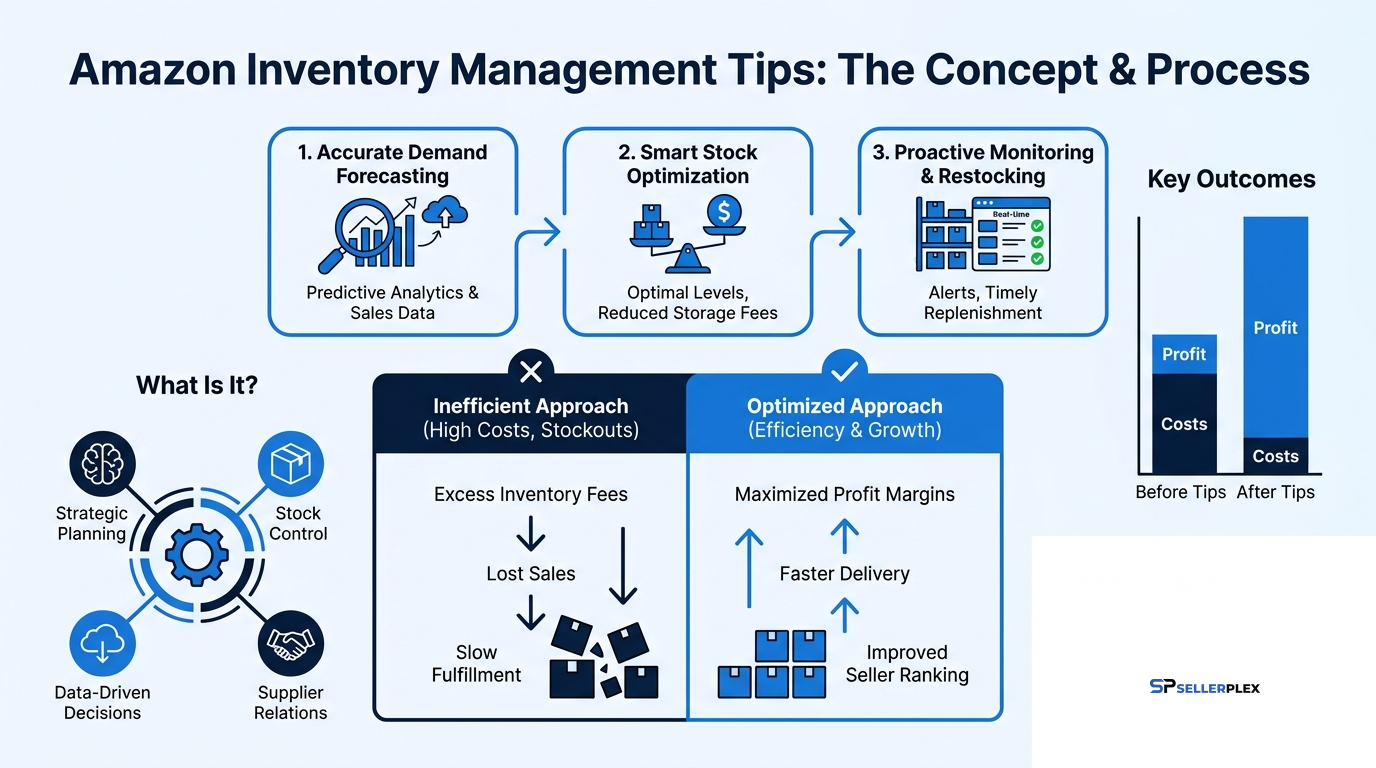
Amazon inventory management tips are the operating practices you use to keep the right amount of stock in the right place at the right time. In practical terms, that means forecasting demand, setting reorder points, planning FBA shipments, coordinating with suppliers, and monitoring how fast units move through the network.
For a scaling seller, this matters because Amazon punishes both extremes. If you run out, you lose sales velocity and often hurt organic rank. However, if you overstock, you increase carrying costs, storage fees, and aged-inventory exposure. According to Amazon’s own guidance on inventory management, healthy sell-through and in-stock rates support a more stable operation and better use of fulfillment capacity.
Therefore, the best amazon inventory management tips are not just about software dashboards. They are about building a repeatable system that connects demand planning, logistics, and cash flow. If you already invest in Amazon PPC management or broader Amazon FBA supply chain strategy, better inventory control multiplies the return on that spend.
80+ in-house specialists across PPC, supply chain, account management and content.
How It Works
At a high level, amazon inventory management tips work by turning historical sales and supply-chain constraints into clear replenishment decisions. Instead of reordering when stock “looks low,” you define thresholds and time buffers.
1. Forecast demand by SKU
First, review trailing sales by SKU, channel, and season. Then adjust for promotions, ad pushes, Prime events, and expected ranking changes. These amazon inventory management tips start with a real forecast, not a gut call.
2. Calculate lead time accurately
Next, break lead time into stages: supplier production, prep, inland transit, ocean or air freight, customs, carrier delays, and Amazon receiving. Many sellers underestimate this step, which creates fake confidence.
3. Set reorder points and safety stock
Additionally, set a reorder point based on average daily sales multiplied by lead time, then add safety stock for variability. This gives you a decision trigger before you hit a stockout zone.
4. Split inventory by destination
For example, some units may go to FBA, some to a 3PL, and some may stay with the supplier. That split helps you stay flexible when inbound limits or receiving delays hit.
5. Monitor and adjust weekly
Finally, compare plan versus actual performance every week. If sales accelerate, lead times slip, or storage costs spike, update the plan before the gap compounds. In other words, amazon inventory management tips only work when your team reviews and acts.
In other words, strong amazon inventory management tips create a closed loop: forecast, reorder, ship, monitor, adjust.
Key Benefits
Better amazon inventory management tips improve more than fill rate. They also strengthen margin
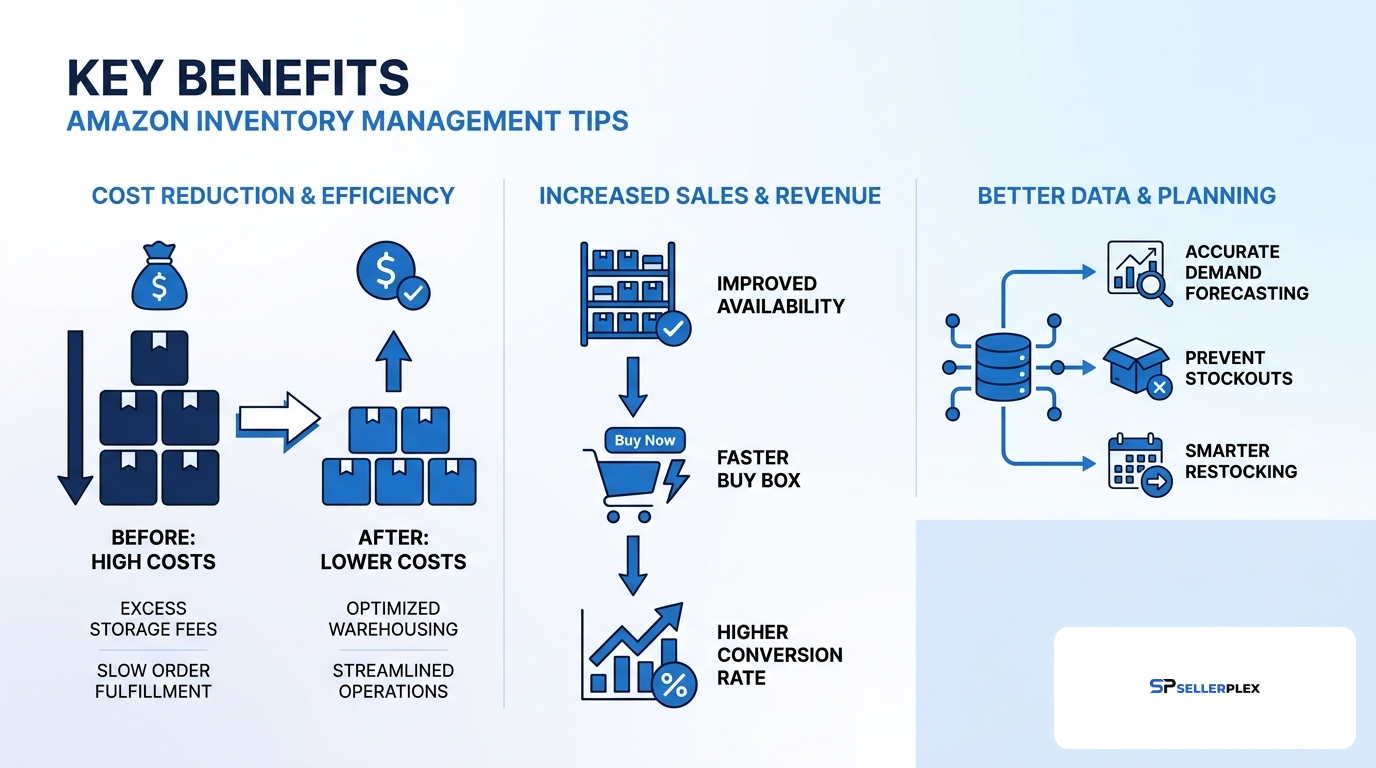
, planning accuracy, and cash efficiency.
1. Fewer stockouts
- First, you protect revenue by avoiding lost buy-box time and dead ad spend on unavailable SKUs.
2. Lower storage and aged-inventory fees
- Additionally, cleaner reorder timing reduces the risk of overbuying units that sit too long in the network.
3. Better cash-flow control
- Because inventory is one of the largest cash drains for many sellers, tighter planning frees capital for growth.
4. More stable ad performance
- If inventory stays in stock, your campaigns do not need to restart momentum after every interruption. That is especially important if you follow a structured Amazon PPC 2026 playbook.
5. Smarter supplier negotiations
- Moreover, stronger forecasting gives you better visibility into PO timing, container planning, and order volume.
6. Less operational firefighting
- As a result, your team spends less time expediting emergency shipments and more time improving systems.
7. Better performance signals for Amazon
- According to Amazon, inventory health metrics such as sell-through and excess inventory directly affect how efficiently your catalog performs inside FBA. Therefore, amazon inventory management tips support broader account health.
Step-by-Step Guide
If you want amazon inventory management tips that actually work, use this sequence every week.
Step 1: Segment your SKUs by velocity and importance
Start by separating A, B, and C SKUs based on sales velocity, margin, and strategic value. Your top sellers need tighter review cycles and more conservative safety stock.
Pro Tip: Do not treat every SKU the same. A hero ASIN with high ad support deserves a different buffer than a slow seasonal product.
Step 2: Build a rolling 12-week demand forecast
Next, combine trailing 8 to 12 weeks of sales with known demand drivers. For example, include promotional windows, price changes, ad ramps, and marketplace expansion. If your catalog is complex, the discipline used in Best Product Research Tools and a structured account review becomes essential.
Step 3: Measure true lead time, not ideal lead time
Then calculate the full path from PO placement to sellable FBA inventory. Include manufacturing, inspections, booking, port delays, customs, prep, check-in, and receiving. However, also keep a “risk lead time” version based on recent delays, not your best-case scenario.
Step 4: Set reorder points and safety stock by SKU
Use a simple formula first: average daily sales × lead time days + safety stock. Additionally, increase safety stock for volatile SKUs, fragile supplier relationships, or products exposed to seasonal spikes. These amazon inventory management tips become more reliable when you document the assumptions.
Step 5: Decide your inventory placement strategy
Now choose how much stock should sit in FBA, 3PL, or upstream with your supplier. This is one of the most useful amazon inventory management tips because it protects flexibility. If Amazon receiving slows down, your 3PL can bridge the gap.
Step 6: Align purchasing with storage-fee reality
Before placing a large PO, review monthly and aged inventory fees. According to Amazon’s FBA fee structure, long-term storage exposure can turn a “bulk discount” into a margin leak. Therefore, buying deeper is not always buying smarter.
Step 7: Create a weekly exception report
Finally, review only the SKUs that need action: stockouts within 30 to 45 days, overstock beyond target cover, delayed shipments, and mismatched forecast versus actual sales. That keeps your team focused on decisions, not dashboards. In practice, the best amazon inventory management tips are the ones your team repeats every week.
Fix Replenishment Before It Hurts Margin
Get a hands-on supply chain audit to tighten forecasting, reorder timing, and FBA shipment planning.
Best Tools & Resources
The best amazon inventory management tips combine process with a few trusted resources.
Amazon Seller Central Inventory tools
First, Amazon’s own inventory planning resources help you review restock recommendations, sell-through, and excess inventory signals. Start with the official Amazon inventory management guidance.
Amazon FBA fee documentation
Additionally, review the official Fulfillment by Amazon fee documentation before placing large POs. Storage costs and fee changes can shift reorder economics.
Helium 10
For example, Helium 10 offers operational reporting and demand visibility that many sellers use to spot trend shifts faster. Its broader dataset can support forecast reviews when SKU count rises. You can also review its educational resources on Amazon inventory management strategies.
Jungle Scout
Moreover, Jungle Scout can help validate category demand, seasonality, and market context. That is useful when you launch new products or test adjacent niches.
A strong operating partner
If you need execution, not just dashboards, a partner with supply chain management support and Amazon account management can connect forecasting, replenishment, and operational follow-through.
Common Mistakes to Avoid
Many sellers know the theory but still miss the basics in execution. These amazon inventory management tips matter most when you avoid the errors below.
Relying on one average sales number
If you use only a single trailing average, you can miss seasonality, ad spikes, or channel-specific demand. Instead, review trend direction and event-driven changes.
Ignoring receiving delays at Amazon
However, many teams still plan as if shipped units are instantly available. In reality, receiving delays can create a painful inventory gap even when product is technically “in transit.”
Overordering to chase unit-cost savings
Additionally, deeper buys often look smart on landed cost but weak on cash conversion. If those units age inside FBA, your margin shrinks.
No 3PL buffer strategy
Without a backup node, you lose flexibility when inbound limits or carrier delays appear. Therefore, a 3PL is often an operational hedge, not overhead.
Managing inventory separately from marketing
If your ad team scales spend while ops sees low cover, you create self-inflicted stockouts. Connect replenishment with demand generation. Articles like Amazon ecommerce trends in 2026 and Amazon FBA Optimization: The Ultimate Guide to Scaling Your Business in 2026 show why these systems now move together.
Advanced Tips & Strategies
Once the basics are stable, these advanced amazon inventory management tips can improve resilience and margin.
Use forecast bands, not one forecast
Instead of a single demand number, build base, upside, and downside scenarios. Then map different PO and freight decisions to each case.
Separate launch inventory from steady-state inventory
For example, a new ASIN should have its own planning logic. Launch volatility is usually too high for the same reorder formulas you use on mature SKUs.
Tie freight mode to contribution margin
Moreover, decide when expedited freight still makes economic sense. If an air shipment preserves ranking and contribution profit, the math may justify it.
Monitor weeks of cover by channel
Do not look only at total units. Look at how many weeks of stock you have by Amazon marketplace, FBA node, and reserve location. That gives you a truer picture of exposure.
Build escalation triggers early
Finally, define action thresholds in advance: for instance, under 35 days of cover for hero SKUs, over 120 days for slow movers, or receiving delays beyond a set number of days. These thresholds turn amazon inventory management tips into a real operating cadence.
Pro Tip: The best operators do not wait for a dashboard to look red. They define the red line before the problem starts.
Frequently Asked Questions
What are the most important amazon inventory management tips for growing sellers?
The most important amazon inventory management tips are to forecast demand by SKU, calculate true lead time, set reorder points with safety stock, and review exceptions every week. Those four controls reduce both stockouts and excess inventory.
How often should you review Amazon inventory levels?
You should review core inventory signals weekly, and you should review hero SKUs more often during promotions or seasonal periods. High-velocity catalogs usually need a tighter operating rhythm than smaller accounts.
How do you calculate a reorder point for Amazon?
A basic reorder point equals average daily sales multiplied by lead time days, plus safety stock. However, you should adjust that formula if demand is volatile or supplier performance is inconsistent.
Why do Amazon sellers still stock out even with forecasting tools?
Many sellers stock out because they use ideal lead times, ignore Amazon receiving delays, or fail to connect ad plans with replenishment timing. The tool is rarely the full problem. Execution discipline usually is.
Should you keep all your inventory in FBA?
No, not always. Many sellers perform better with a split between FBA and a 3PL because it creates flexibility when receiving slows or storage costs rise. The right mix depends on demand stability, SKU size, and lead-time risk.
What is a healthy amount of safety stock for Amazon inventory?
There is no universal number because safety stock should reflect demand variability, supplier reliability, and shipping risk. Higher-volatility SKUs usually need a larger buffer than stable replenishment products.
Next Steps
Conclusion
The best amazon inventory management tips are simple in theory but hard in execution. You need accurate demand signals, realistic lead times, clear reorder points, and a weekly exception process that your team actually follows.
If your catalog is growing and inventory decisions keep leaking margin, now is the time to tighten the system. SellerPlex helps Amazon brands improve forecasting, FBA shipment planning, supplier coordination, and stock-level control through hands-on supply chain management services. If you want help applying these amazon inventory management tips inside your operation, that is the right next step.
Ready to Grow Your Amazon Business?
Book a free strategy session with our Amazon and e-commerce specialists. No obligations, just actionable insights.
Related reading: Amazon Tools Provider.
Amazon supply chain management →
Inventory planning, freight and 3PL coordination from factory to FBA, so stockouts stop costing you sales.
Want more of this in your Google results? Add SellerPlex as a preferred source.