

TL;DR: A leaner supply chain starts with mapping the true lead time from purchase order to Amazon check-in, since most brands track only the supplier’s promise date. Forecast demand by SKU eight to sixteen weeks out, set reorder points and safety stock per SKU, and route shipments through FBA, a 3PL, or upstream storage depending on what keeps you flexible. Review exceptions weekly.
Amazon sellers rarely lose momentum because demand disappears. More often, they lose margin because the amazon fba supply chain breaks at the worst possible moment. You run out of stock, overpay for freight, miss check-in windows, or send inventory into the wrong node at the wrong time. As a result, sales slow down while fees keep climbing.
Table of Contents
This guide shows you how to manage the amazon fba supply chain with tighter forecasting, cleaner inbound planning, and better cost control. Additionally, you will learn the core workflow, the biggest mistakes, the best tools, and the advanced tactics that help you protect inventory health as you scale.
Introduction
Amazon sellers rarely lose momentum because demand disappears. More often, they lose margin because the amazon fba supply chain breaks at the worst possible moment. You run out of stock, overpay for freight, miss check-in windows, or send inventory into the wrong node at the wrong time. As a result, sales slow down while fees keep climbing.
This guide shows you how to manage the amazon fba supply chain with tighter forecasting, cleaner inbound planning, and better cost control. Additionally, you will learn the core workflow, the biggest mistakes, the best tools, and the advanced tactics that help you protect inventory health as you scale.
What Is Amazon FBA Supply Chain?
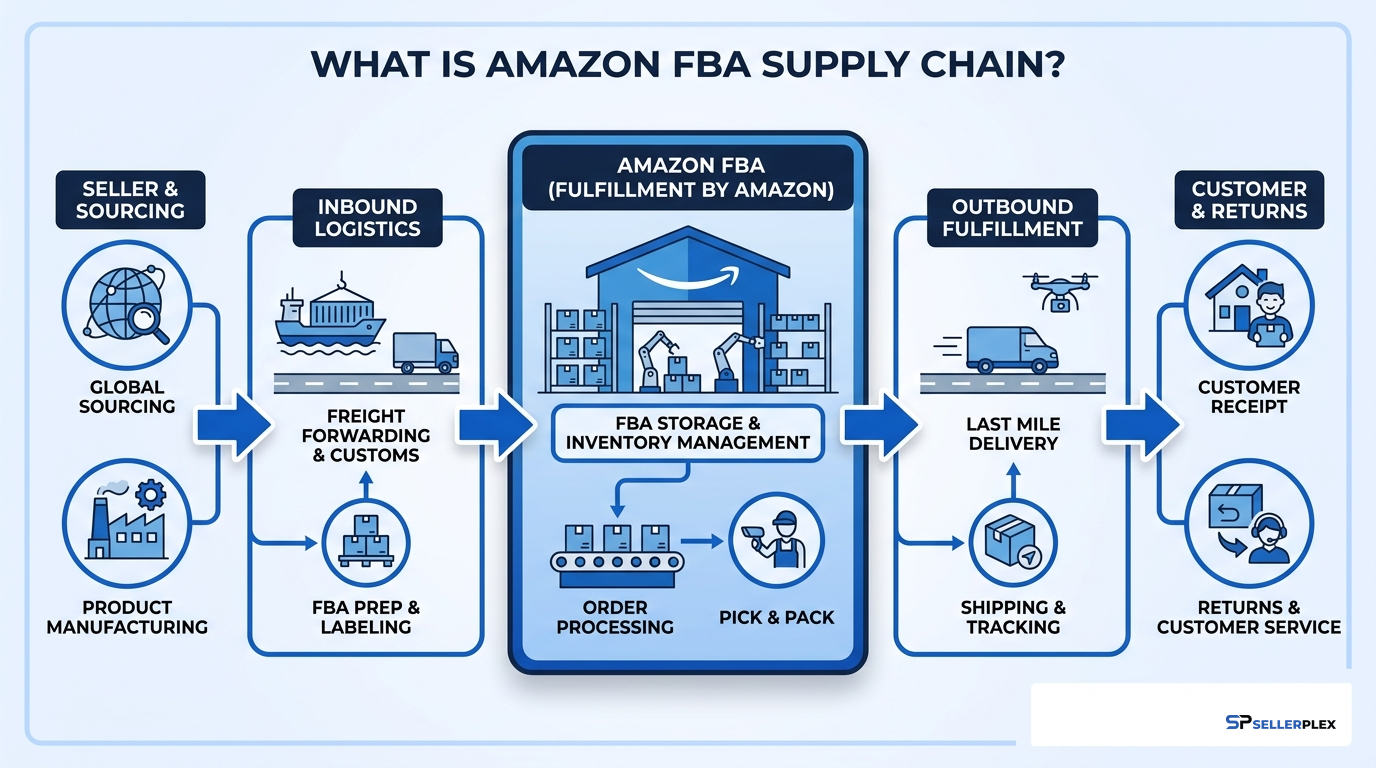
The amazon fba supply chain is the full operating system behind how your products move from supplier to Amazon fulfillment centers and then to the customer. In practice, it includes demand planning, production timing, freight coordination, customs, warehouse handoffs, FBA shipment creation, replenishment rules, and ongoing stock monitoring.
For a 7 or 8 figure brand, the amazon fba supply chain is not just a logistics topic. Instead, it is a margin topic. Amazon has continued to tighten capacity rules, inbound preferences, and fee structures, while customer expectations remain fast and unforgiving. According to Amazon, sellers using Fulfillment by Amazon gain access to Prime shipping and Amazon’s fulfillment network, but that advantage only works when inventory arrives on time and in the right quantities. You can review Amazon’s own FBA overview in Sell on Amazon: Fulfillment by Amazon.
Therefore, if you want stable growth, you need a supply chain that supports both cash flow and sell-through. That is why many brands pair FBA execution with broader supply chain management support instead of treating shipping as a one-off task.
80+ in-house specialists across PPC, supply chain, account management and content.
How It Works
The amazon fba supply chain works as a connected series of decisions rather than a single shipping event. First, you forecast expected demand by SKU, channel, and seasonality. Next, you align production with reorder points and supplier lead times. Then you move units through freight, storage, and Amazon’s inbound network.
1. Forecast demand by SKU
You start with sales history, trend shifts, advertising plans, and seasonality. For example, if your PPC spend increases by 20%, your future unit demand often rises as well. Therefore, your amazon fba supply chain forecast should reflect both organic and paid demand.
2. Set reorder points and buffers
Next, you define when to reorder based on lead time, transit variability, and desired days of coverage. A healthy amazon fba supply chain usually includes a safety stock buffer, especially for long-lead imported goods.
3. Coordinate inbound logistics
Then you book freight, prepare cartons or pallets to Amazon specifications, and choose whether inventory should go direct to FBA, through a 3PL, or through Amazon Warehousing and Distribution. Amazon explains its end-to-end network options in Supply Chain by Amazon.
4. Create and route FBA shipments
After that, you build shipment plans in Seller Central, label inventory correctly, and monitor check-in timelines. If routing is poor, your FBA supply chain slows down and storage fees can rise.
5. Monitor sell-through and replenish
Finally, you track stock levels, restock limits, stranded inventory risk, and days on hand. Because conditions shift weekly, the supply chain needs active management, not monthly guesswork.
Key Benefits
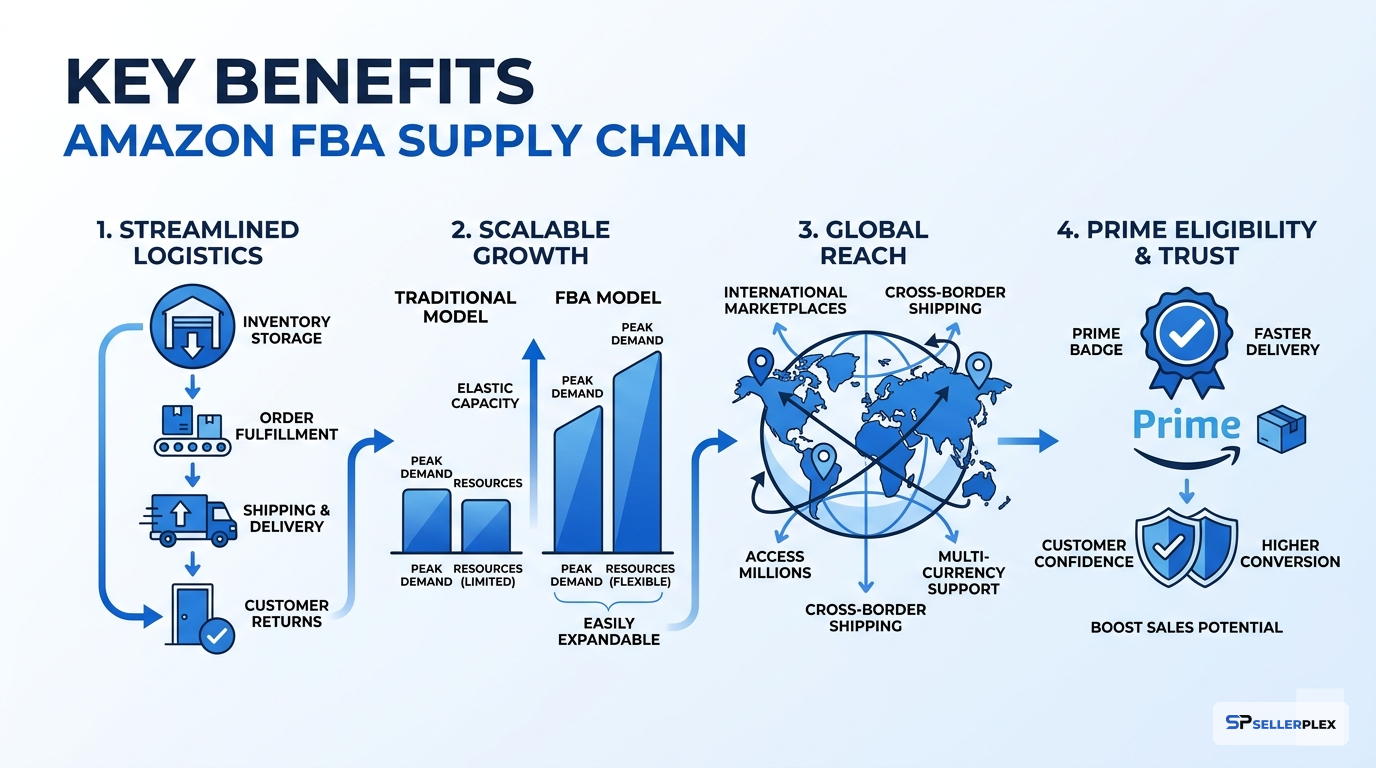
A well-run FBA logistics gives you more than operational cleanliness. More importantly, it creates financial leverage.
Better in-stock performance
When forecasting and reorder timing improve, you reduce stockouts. Consequently, you protect ranking, conversion rate, and ad efficiency instead of rebuilding momentum after every inventory gap.
Lower emergency freight spend
A disciplined your supply chain reduces last-minute air shipments. That matters because rush freight can erase margin faster than almost any other operating cost.
Stronger cash flow planning
When you know how much inventory to buy and when to move it, cash planning becomes more predictable. Therefore, you can avoid tying up working capital in excess stock.
Cleaner FBA replenishment
With tighter inbound planning, you send the right units at the right time. As a result, your inventory is more likely to arrive before demand spikes rather than after them.
Better fee control
Storage, aged inventory, and placement costs all respond to how you manage the FBA fulfillment chain. Better routing and smarter inventory turns usually reduce unnecessary fee exposure.
Improved supplier accountability
When purchase orders, deadlines, and lead times are documented, supplier conversations become clearer. Additionally, you can spot weak partners before they create peak-season problems.
Easier scaling across multiple SKUs
As SKU count rises, complexity rises faster. A structured fulfillment pipeline helps you scale without relying on founder memory and spreadsheet heroics.
Step-by-Step Guide
If you want to improve your FBA operations, use the following workflow.
Step 1. Audit your current lead times
First, map every stage from purchase order to FBA check-in. Include supplier production, prep, drayage, customs, ocean or air transit, warehouse receiving, and Amazon check-in. Most brands underestimate total lead time because they track only the supplier promise date.
Step 2. Build a SKU-level demand forecast
Next, forecast 8 to 16 weeks forward by SKU. Use historical sales, promotional calendar changes, seasonality, and ad plans. If you are scaling a brand with multiple moving parts, review lessons from the Amazon FBA agency guide so your inventory plan matches your growth targets.
Step 3. Set reorder points and safety stock
Then calculate reorder points based on average daily sales, lead time, and a realistic buffer for delays. However, do not use one blanket rule for every SKU. Fast movers, seasonal items, and bulky products all need different logic.
Step 4. Segment inventory by velocity
After that, sort SKUs into A, B, and C groups based on volume, margin, and volatility. Your Amazon’s logistics network should prioritize close monitoring for the SKUs that drive the most revenue and the most risk.
Step 5. Choose the right inbound path
Next, decide whether each shipment should go direct to FBA, through a 3PL, or through Amazon’s upstream storage options. For example, a 3PL can help you drip feed inventory into FBA when restock limits or storage concerns make direct bulk sends risky.
Step 6. Standardize shipment planning
Then create a repeatable shipment checklist. Include carton dimensions, pallet configuration, labeling, carrier booking, appointment timing, and tracking documentation. A repeatable process reduces preventable delays in the the supply chain.
Step 7. Monitor exceptions weekly
Additionally, review delayed POs, customs holds, missed production dates, FBA receiving lags, and low-stock alerts every week. This is where structured operating support, paired with insights from Amazon product listing optimization, often adds value because issues get escalated before they become revenue problems.
Step 8. Tie supply chain data to margin
Finally, measure the real impact of your your FBA supply chain. Track stockout days, expedited freight cost, storage fees, reorder accuracy, and landed cost trends. If your ops data never connects to profit, you will miss the point.
Pro Tip: Build your forecast around the next decision window, not the full year. In other words, make the next purchase order more accurate first, then improve the system over time.
Fix FBA Inventory Bottlenecks
Get a clear plan to forecast demand, tighten replenishment, and lower avoidable logistics costs.
Best Tools and Resources
The best FBA supply chain stack combines Amazon-native visibility with demand and profitability tools.
Amazon Seller Central
First, use Seller Central for FBA shipment creation, inventory health monitoring, restock insights, and stranded inventory checks. It is the operational core of your supply chain.
Amazon Supply Chain by Amazon
Additionally, Amazon’s upstream logistics network can help sellers simplify parts of inbound movement and storage. Review the official overview at Supply Chain by Amazon.
Helium 10
Helium 10 is useful for sales trend analysis, keyword demand signals, and market context that can improve your forecast assumptions. You can explore its resource center at Helium 10.
Jungle Scout
Jungle Scout provides market and sales estimation data that can support planning for launches and category expansion. See Jungle Scout for demand research resources.
Internal operating dashboards
Finally, your own reorder dashboard often becomes the most important tool. A strong FBA logistics depends on one source of truth for lead times, on-hand units, inbound inventory, and reorder dates.
Common Mistakes to Avoid
Even experienced brands mismanage the your supply chain in predictable ways.
Mistake 1. Forecasting from old averages only
If you rely only on trailing averages, you ignore promos, ad changes, and new competitive pressure. Consequently, your reorder timing drifts out of sync with reality.
Mistake 2. Treating every SKU the same
Not every item deserves the same days of cover or the same reorder rule. High-velocity or high-margin SKUs need tighter control. Otherwise, your FBA fulfillment chain becomes too generic to protect the products that matter most.
Mistake 3. Sending too much inventory to FBA
More inventory does not always mean more safety. In fact, excess stock can increase storage fees, reduce flexibility, and slow cash conversion.
Mistake 4. Ignoring inbound receiving delays
Many teams stop tracking once the shipment leaves the warehouse. However, Amazon receiving delays still affect stock availability. If you do not model that lag, the fulfillment pipeline looks healthier than it really is.
Mistake 5. Separating ops from marketing
Supply chain and demand generation have to work together. For example, if your ad team pushes spend while inventory is thin, you may accelerate stockouts instead of growth. That is why Amazon PPC management and operations planning should stay aligned.
Pro Tip: Run a weekly exception review with one owner. When everyone owns the FBA operations, nobody really owns it.
Advanced Tips and Strategies
Once the basics are stable, you can improve the Amazon’s logistics network with more sophisticated controls.
Use scenario-based forecasting
Instead of keeping one forecast, build base, upside, and downside cases. Therefore, you can place inventory bets with a clearer view of risk.
Split inbound across nodes intentionally
For some products, it makes sense to hold a portion in a 3PL or AWD while sending only near-term demand into FBA. This keeps the the supply chain more flexible when fees or restock limits change.
Link launch plans to reorder logic
New launches often distort forecasting because early velocity is volatile. However, if you map promotional spend, coupon plans, and review goals in advance, you can adjust your your FBA supply chain without guessing.
Track supplier reliability as a KPI
Do not just track unit cost. Also measure on-time delivery rate, defect issues, and responsiveness. A slightly more expensive supplier can improve the FBA supply chain if reliability prevents stockouts.
Build post-mortems after every stockout
Finally, treat every stockout like a preventable operations failure. Review forecast accuracy, PO timing, freight mode, receiving lag, and owner accountability. Over time, those reviews tighten the supply chain far faster than generic reporting.
Frequently Asked Questions
What is the FBA logistics?
The your supply chain is the full process of forecasting demand, ordering inventory, moving goods through freight and storage, sending stock into Amazon fulfillment centers, and replenishing inventory based on sales and lead times.
How is the FBA fulfillment chain different from basic FBA shipping?
Basic FBA shipping focuses on sending inventory to Amazon. The fulfillment pipeline is broader because it covers supplier planning, reorder logic, warehouse coordination, freight timing, and ongoing stock control.
How much safety stock should you hold in an FBA operations?
The right safety stock depends on SKU velocity, supplier reliability, freight mode, and receiving variability. Most brands should calculate buffer stock from real lead-time risk instead of using one fixed rule across all products.
Should you send all inventory directly into FBA?
Not always. In many cases, it is smarter to split inventory between FBA and a 3PL or other upstream storage option so you can lower storage exposure and respond more flexibly to restock changes.
What metrics matter most in an Amazon’s logistics network?
The most useful metrics include days of cover, forecast accuracy, reorder accuracy, stockout days, expedited freight cost, receiving delay, storage fees, and landed cost by SKU.
Can better supply chain planning improve Amazon advertising performance?
Yes. When your products stay in stock, your ads can keep converting efficiently. Inventory gaps often reduce ranking and force you to spend more later to regain momentum, which is why supply chain and media planning should stay connected.
Conclusion
A strong the supply chain gives you more than cleaner operations. It protects margin, supports ad efficiency, and reduces the chaos that slows scaling brands down. However, that only happens when forecasting, inbound planning, supplier coordination, and replenishment all work together.
Next Steps
If your your FBA supply chain still depends on reactive reorder decisions, you are probably leaking margin in ways that do not show up until it is too late. However, when you tighten forecasting, inbound planning, and replenishment logic, you create a more durable growth engine.
The fastest next move is to audit your lead times, segment your SKUs, and fix the products that drive the most revenue risk first. If you want help building a tighter FBA supply chain, SellerPlex can support forecasting, FBA shipment planning, supplier coordination, and ongoing inventory control through its supply chain management service.
Ready to Grow Your Amazon Business?
Book a free strategy session with our Amazon and e-commerce specialists. No obligations, just actionable insights.
Related reading: Best Analytics Tools for Ecommerce.
Amazon supply chain management →
Inventory planning, freight and 3PL coordination from factory to FBA, so stockouts stop costing you sales.
Want more of this in your Google results? Add SellerPlex as a preferred source.