

TL;DR: Start with a 60 to 90 day performance audit so you see sessions, click-through rate, and conversion rate before changing anything, since opinions about the copy alone do not hold up. Then map keywords by search intent, rewrite the title and bullets around buyer objections with specific details, upgrade images to reduce uncertainty, and strengthen A+ Content without repeating the bullets word for word.
Introduction
If your traffic is flat, your conversion rate is weak, or your PPC costs keep rising, amazon product listing optimization is usually the first lever to fix. Amazon rewards listings that earn clicks, convert consistently, and match shopper intent. In other words, better listing quality improves both paid and organic performance.
Table of Contents
In this guide, you’ll learn how amazon product listing optimization works, which listing elements move revenue fastest, and how to improve titles, bullets, images, A+ Content, and backend terms without guessing. Additionally, you’ll see the common amazon product listing optimization mistakes that keep strong products buried in search results.
What Is Amazon Product Listing Optimization?
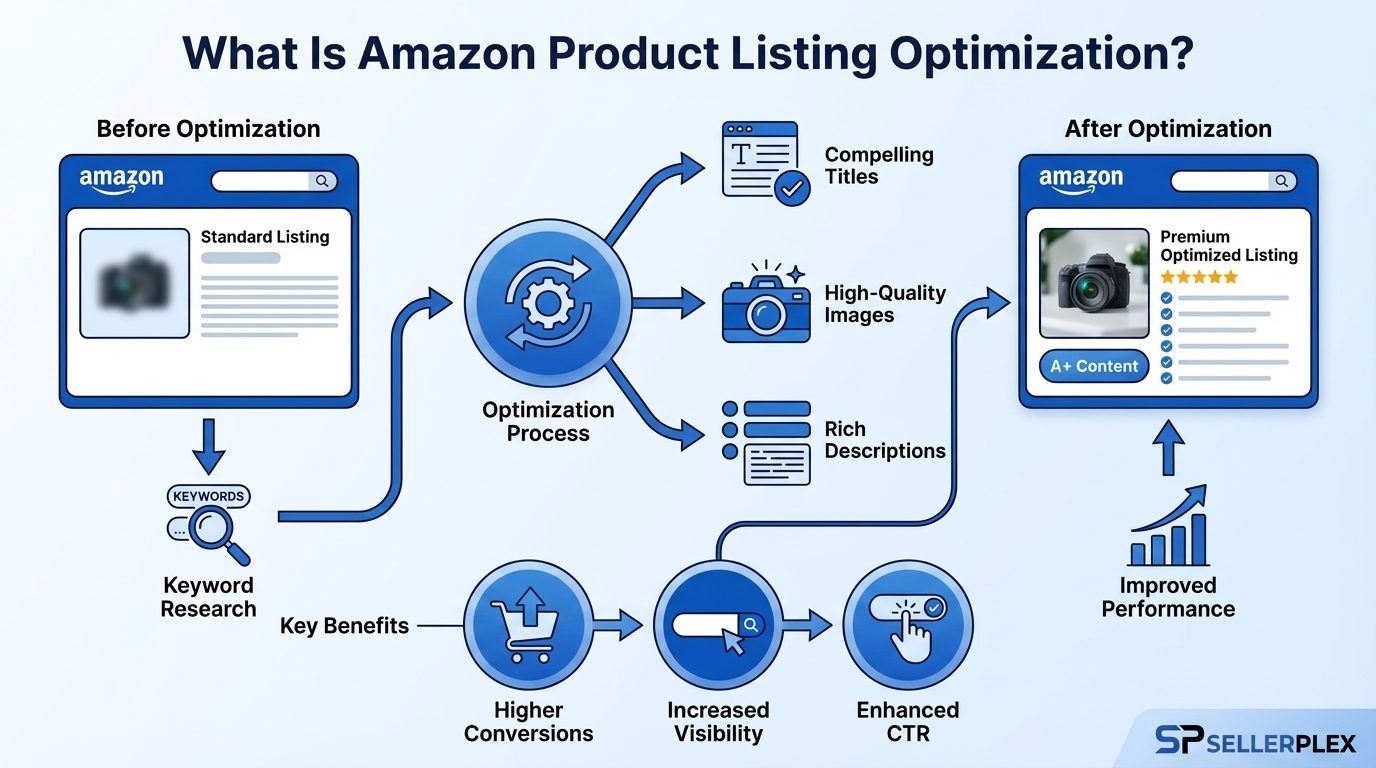
Amazon product listing optimization is the process of improving every searchable and conversion-driving element on a product detail page so you rank for relevant terms and convert more shoppers once they land. Specifically, that includes your title, bullet points, product description, images, A+ Content, backend search terms, and category placement.
For 7- and 8-figure sellers, this matters because listing quality directly affects margin. In addition, if your product detail page underperforms, you often compensate with higher ad spend. However, stronger listings can lower wasted clicks and improve conversion rate, which supports better organic rank over time. Amazon itself notes that complete, high-quality product pages help customers discover and evaluate products more effectively through search and detail page content (Amazon Seller Central).
Current trends make optimization even more important. Furthermore, search results are more competitive, mobile shopping continues to dominate, and shoppers compare products fast. As a result, weak creative, vague copy, or poor keyword targeting can cost you both visibility and profit.
80+ in-house specialists across PPC, supply chain, account management and content.
How It Works
Effective amazon product listing optimization works by aligning your listing with two systems at the same time: Amazon’s search engine and shopper behavior. Understanding both sides of amazon product listing optimization is what separates marginal tweaks from meaningful revenue gains.
1. Amazon matches your listing to search intent
First, Amazon indexes your title, bullets, backend terms, and category signals. When shoppers search, the algorithm evaluates which products appear most relevant to that query. Therefore, if your copy misses high-intent terms, your discoverability suffers before conversion even becomes a factor.
2. Shoppers decide in seconds whether to click
Next, your main image, title clarity, price, ratings, and delivery promise influence click-through rate. If your listing looks generic, shoppers skip it. In contrast, a clear value proposition and strong visual presentation can lift traffic without increasing bids.
3. Conversion signals reinforce rank
Once shoppers land on the page, Amazon watches performance signals such as conversion rate, sales velocity, and engagement. According to marketplace research from Jungle Scout, better copy and images can improve conversions because shoppers understand the product faster and trust the offer more.
4. Better listings improve paid efficiency too
Finally, optimized listings make PPC work harder. When more clicks convert, your ad budget produces more revenue. That is why strong brands often pair listing upgrades with Amazon PPC management instead of treating copy and media as separate workstreams.
Key Benefits
Done well, amazon product listing optimization improves more than rankings. The benefits of amazon
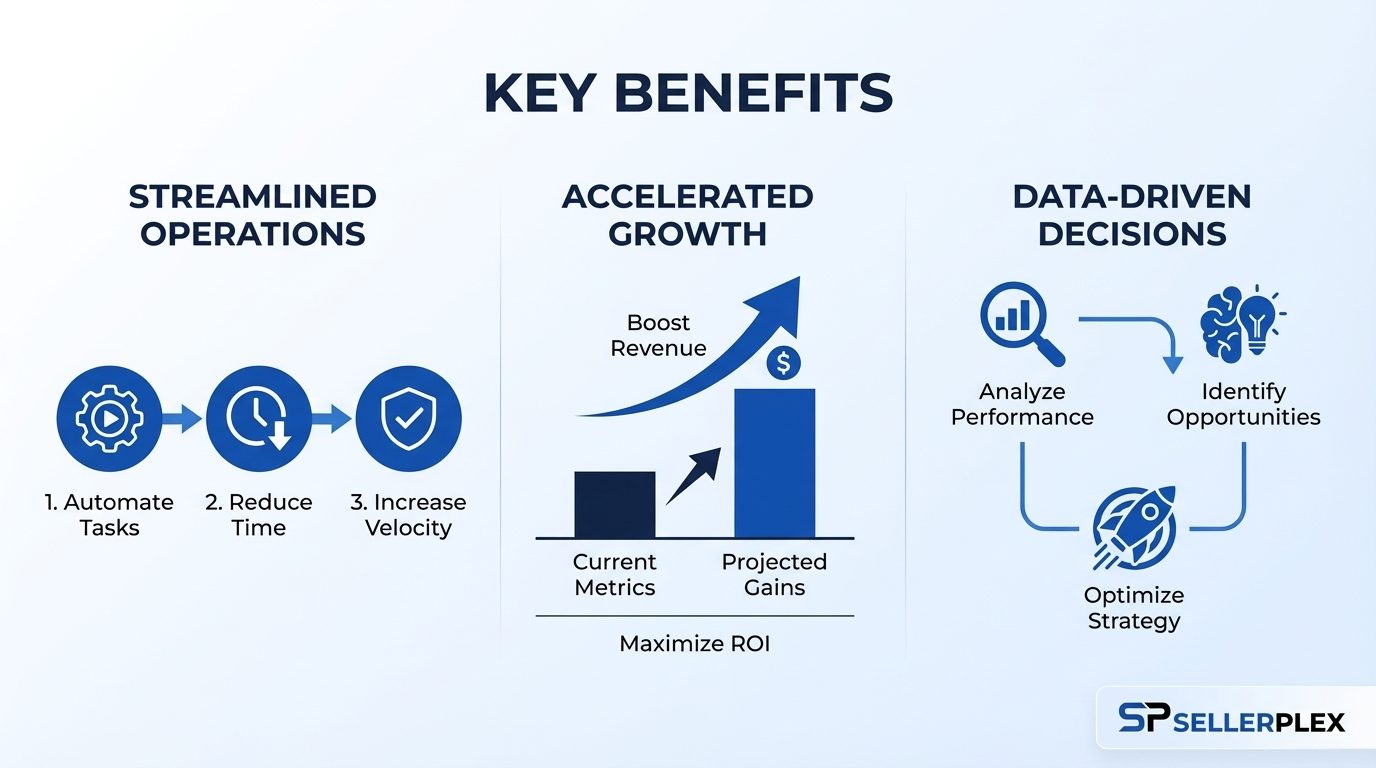
product listing optimization impact revenue efficiency across your entire account.
Higher organic visibility
- Better keyword alignment helps Amazon index your product for more relevant terms.
- Additionally, higher conversion rates can reinforce organic position over time.
Better click-through rate
- Clear titles and stronger hero images help you win the first decision in search results.
- Even a modest CTR lift can produce meaningful revenue at scale.
Higher conversion rate
- Better bullets, images, and A+ Content answer objections faster.
- According to Amazon, richer product content helps customers make more confident purchase decisions.
Lower wasted ad spend
- When your listing converts more efficiently, each paid click becomes more valuable.
- Therefore, your effective acquisition cost can improve without cutting traffic.
Stronger brand differentiation
- Optimized listings make feature differences easier to understand.
- This matters most in crowded categories where similar products look interchangeable.
More resilient rankings during competition spikes
- Better conversion performance gives you a stronger base when CPCs rise or competitors increase promotions.
- That also supports broader account performance, especially if you manage multiple ASINs through Amazon account management services.
Better cross-channel performance
- Listing quality improves the destination page for traffic from DSP, influencers, and external campaigns.
- In other words, optimization supports the full funnel, not just Amazon SEO.
Step-by-Step Guide
Use this structured process to execute amazon product listing optimization without random edits or keyword stuffing. A methodical approach to amazon product listing optimization ensures every change is measurable.
Step 1: Audit current performance
Start with business metrics, not copy opinions. Review sessions, unit session percentage, CTR from ads, CVR by ASIN, and top search terms. Additionally, compare high-traffic and low-conversion products to spot where the problem sits.
Pro Tip: Pull a 60- to 90-day baseline before making changes. Otherwise, seasonality can hide what actually improved.
Step 2: Map search intent by keyword cluster
Group keywords into primary, secondary, and feature-specific clusters. For example, separate broad discoverability terms from attributes like size, material, use case, or compatibility. Consequently, your copy will reflect how shoppers actually search instead of forcing every keyword into one sentence.
Step 3: Rewrite the title for clarity and relevance
Your title should communicate product type, core differentiator, and major search intent fast. Keep it readable on mobile. Moreover, front-load the most important terms because shoppers often scan only the first portion.
Step 4: Rebuild bullets around buyer objections
Each bullet should answer one buying question: what it does, who it is for, why it performs better, how it solves a problem, and what makes it credible. Use specifics. For instance, dimensions, compatibility, usage context, or material claims outperform generic claims like “premium quality.”
Step 5: Upgrade images for decision speed
Add images that reduce uncertainty, not just decorate the page. Include a clean hero image, feature callouts, dimension visuals, comparison frames, and lifestyle context where relevant. If your creative is weak, Amazon content creation services can improve both conversion and brand perception.
Step 6: Strengthen A+ Content and brand story
A+ Content should reinforce differentiation and simplify comparison. However, it should not repeat your bullets word for word. Use modules to explain use cases, prove expertise, and guide shoppers to the right product fit.
Step 7: Refine backend search terms and attributes
Use backend terms for indexing gaps, alternate spellings, and relevant synonyms. At the same time, verify category, subject matter, and item attributes. Missing attributes can limit discoverability even when the copy looks strong.
Step 8: Test, measure, and scale winners
After publishing, track changes in CTR, CVR, ad efficiency, and organic rank. Then roll proven patterns across similar ASINs. If you sell multiple SKUs, connect listing updates with inventory and operational planning through supply chain management support so improved demand does not create stockouts.
Turn More Traffic Into Sales
Get a clear plan to improve your Amazon listing copy, images, and conversion points.
Best Tools & Resources
The right amazon product listing optimization tools help you validate decisions, not replace judgment.
Amazon Seller Central
First, use Amazon’s own reports to review search terms, business reports, and contribution from listing changes. Moreover, this should be your source of truth for conversion and sales behavior.
Helium 10
Additionally, Helium 10 listing optimization tools are useful for keyword discovery, indexing checks, and competitive listing analysis. They help you identify terms competitors target and where your copy may be thin.
Jungle Scout
Jungle Scout is useful for market context, keyword research, and competitor benchmarking. It is especially helpful when you need a faster read on category language and offer positioning.
SellerPlex related guides
For broader account performance, review Amazon FBA optimization and Amazon PPC cost in 2026. These resources help you connect listing quality to inventory flow and media efficiency.
Common Mistakes to Avoid
Most amazon product listing optimization efforts fail because sellers optimize in fragments.
Writing for keywords instead of buyers
If your copy reads like a keyword dump, shoppers lose trust. Moreover, Amazon does not reward awkward copy that hurts conversion. Build around intent and readability first.
Treating images as secondary
Many brands spend weeks on title edits but keep low-quality images. That is expensive. In reality, visual assets often influence click and conversion faster than minor copy tweaks.
Repeating the same claims everywhere
If your title, bullets, description, and A+ Content all say the same thing, you waste valuable page real estate. Instead, make each block answer a different buying question.
Ignoring mobile experience
Long titles and dense bullets often look acceptable on desktop but fail on mobile. Since many shoppers browse on phones, poor mobile readability can reduce engagement quickly.
Measuring success too early
Some sellers change a listing and judge results after a few days. However, ranking and conversion shifts need enough traffic and time to evaluate properly. Premature changes can erase signal.
Advanced Tips & Strategies
Once the fundamentals of amazon product listing optimization are in place, use advanced tactics to improve profit, not just traffic.
Build listings by intent segment
Create copy frameworks for distinct search intents such as “gift,” “premium,” “starter,” or “professional use.” As a result, your messaging becomes sharper and easier to test across adjacent ASINs.
Pair optimization with PPC search term mining
Your ad data shows which queries convert, which waste spend, and which need stronger relevance on the page. Therefore, use PPC reports to prioritize listing updates. This is one reason brands reading Amazon PPC 2026 often uncover content gaps, not just bid issues.
Align listing claims with operations reality
Do not promise fast replenishment, premium packaging, or broad compatibility unless operations can support it. Inconsistent claims create returns, bad reviews, and margin loss. Consequently, marketing and operations must work together.
Pro Tip: If review themes point to a mismatch between expectation and delivery, fix the listing before increasing ad spend.
Prioritize catalog patterns, not one-off rewrites
If one message or image style lifts CVR on one ASIN, document the pattern. Then apply it to related products systematically. This creates portfolio-level gains faster than treating every listing as a blank page.
Use reviews as conversion intelligence
Finally, mine reviews and Q&A for exact buyer language. Those phrases often reveal better benefit statements, objection handling, and comparison points than generic copy decks ever will.
Frequently Asked Questions
What is amazon product listing optimization?
Amazon product listing optimization is the process of improving your title, bullets, images, A+ Content, backend terms, and category data so your product ranks for relevant searches and converts more shoppers once they click.
How often should you optimize an Amazon listing?
You should review core listings at least quarterly and immediately after major shifts in conversion rate, ad efficiency, competitor pressure, review trends, or catalog changes. High-volume ASINs deserve more frequent monitoring.
Does amazon product listing optimization help PPC performance?
Yes. Amazon product listing optimization usually improves conversion rate, which means more revenue per click. As a result, your PPC budget can work more efficiently because the product page does a better job closing the sale.
Which part of a listing matters most for conversions?
There is no single element, but main image quality, title clarity, bullet usefulness, and price-value communication usually have the biggest effect first. The strongest results come when those elements work together.
Should you put the keyword everywhere in the listing?
No. You need relevant keyword coverage, but forced repetition hurts readability and trust. Use the primary keyword in critical fields, then support it with natural variations and buyer-focused copy.
What tools help with amazon product listing optimization?
For amazon product listing optimization, Amazon Seller Central, Helium 10, and Jungle Scout are strong starting points for keyword research, competitor analysis, and performance reviews. However, you still need strategic judgment to turn data into conversion-focused copy and creative.
When should you hire help for amazon product listing optimization?
You should get outside help with amazon product listing optimization when your catalog is large, ad costs are rising, creative quality is inconsistent, or internal teams cannot connect keyword research, conversion strategy, and execution. That is usually the point where specialist amazon product listing optimization support creates measurable ROI.
Conclusion: Your Next Steps for Amazon Product Listing Optimization
Amazon product listing optimization is one of the fastest ways to improve ranking quality, conversion rate, and paid efficiency without adding more waste to your budget. If your listing underperforms, the issue is rarely just traffic. More often, the page does not communicate value clearly enough or convert intent efficiently enough.
Start your amazon product listing optimization with your top revenue ASINs, audit the weak points, and prioritize the changes that affect clicks and conversion first. Additionally, if you want an expert review of your copy, creative, and listing structure, explore SellerPlex’s Amazon content creation services to build product pages that convert at a higher rate.
Ready to Grow Your Amazon Business?
Book a free strategy session with our Amazon and e-commerce specialists. No obligations, just actionable insights.
Related reading: What a Good Amazon Listing Optimization Service Actually Does….
Listing copy, A+ Content, brand stories and imagery built to rank and convert.
Want more of this in your Google results? Add SellerPlex as a preferred source.