

TL;DR: Most sourcing cost leaks between the factory quote and landed inventory, in freight, duty, packaging, and emergency air shipments, beyond the unit price. Build a landed cost view per SKU, then negotiate using order history, forecasted volume, and actual lead times, going beyond a simple ask for a lower price. Fixing packaging and reorder points to stop emergency air freight are the fastest wins.
Knowing how to reduce Amazon sourcing costs starts with one uncomfortable truth: most margin leaks are not hiding in the supplier’s unit price. They sit between the factory quote and landed, sellable inventory: freight, duty, packaging, inspection failures, MOQ pressure, storage fees, reorders, and slow decisions.
Table of Contents
- Start With Landed Cost, Not Factory Cost
- Find the Cost Drivers You Can Actually Control
- Renegotiate With Data, Not Pressure
- Reduce Packaging and Freight Waste
- Use Forecasting to Stop Emergency Buying
- Consolidate Suppliers Carefully
- Value Engineer the Product, Not the Customer Experience
- Stop Treating Duties and Compliance as Afterthoughts
- Use Product Research to Avoid Bad Cost Structures
- What Not to Cut
If you are selling at $1M to $10M+ on Amazon, a $0.35 unit cost swing can move more profit than another round of listing tweaks. The mistake is treating sourcing as a purchasing exercise. For Amazon brands, sourcing is a margin system. You need to manage product spec, supplier terms, logistics, inventory velocity, and cash conversion together.
This article breaks down where sourcing costs actually inflate, what to renegotiate first, and how to reduce cost without introducing defects, stockouts, compliance risk, or weaker supplier leverage.
Start With Landed Cost, Not Factory Cost
Your supplier’s quoted unit cost is only one line in the real cost stack. A lower ex-works quote can still produce higher landed cost if the supplier uses inefficient carton dimensions, requires larger MOQs, ships from a worse port, or forces you into air freight because lead times are unreliable.
For each SKU, build a landed cost view that includes:
- Unit manufacturing cost
- Packaging, inserts, labels, and compliance marks
- Product inspection and testing
- Inland freight from factory to port
- International freight
- Duties, tariffs, brokerage, and customs fees
- Amazon prep, 3PL handling, and FBA shipment cost
- Expected defect allowance or replacement cost
- Financing cost tied to the purchase order
Amazon’s own Seller Central guidance on managing sourcing cost points sellers toward understanding product acquisition cost, not just retail pricing. That is the right frame. If your cost model stops at the supplier invoice, you are negotiating blind.
The 3 views every SKU needs
Track sourcing cost in 3 views: factory cost, landed cost, and contribution margin after Amazon fees and ads. Factory cost tells you what the supplier charges. Landed cost tells you what inventory costs before sale. Contribution margin tells you whether the SKU deserves more capital.
This matters because your cheapest supplier may be the most expensive operator. One SellerPlex-style review often finds SKUs where the supplier price looks fine, but carton configuration, slow replenishment, or frequent partial shipments adds 4 to 8 points of margin drag.
If you do not already have SKU-level margin visibility, start there before pushing suppliers for discounts. Our guide to measuring true SKU-level profit before you scale explains why blended margin hides the exact SKUs that need sourcing intervention.
Find the Cost Drivers You Can Actually Control
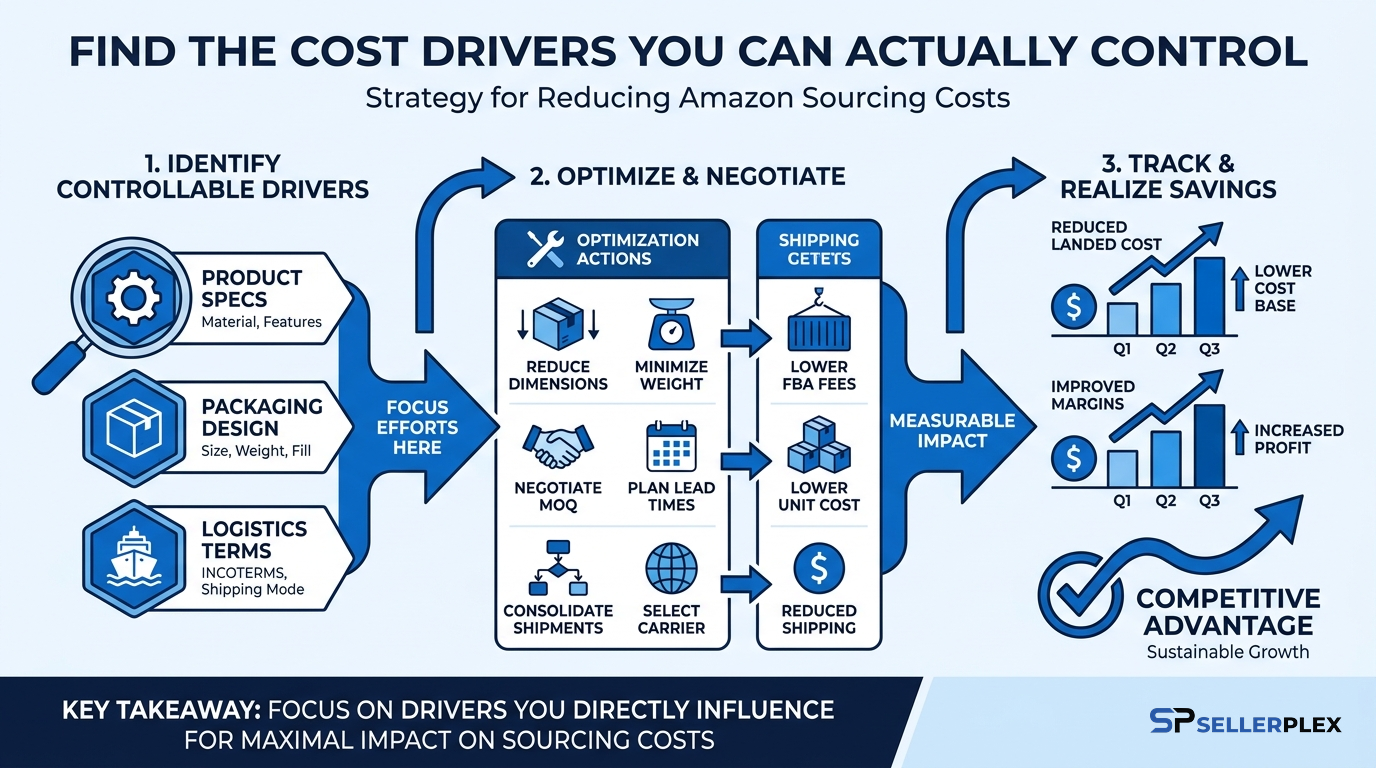
Not every sourcing cost is worth fighting. Commodity input prices, exchange rates, and freight markets can move against you. You still have leverage in spec design, order timing, supplier concentration, packaging, and replenishment discipline.
The best cost reductions usually come from 5 areas:
| Cost lever | What to inspect | Typical fix |
|---|---|---|
| Product spec | Overbuilt materials, excess accessories, unnecessary finishes | Value engineering with quality guardrails |
| MOQ and payment terms | Cash tied up in slow SKUs | Tiered pricing and staged production |
| Packaging | Oversized cartons, fragile inserts, excess dimensional weight | Carton and pack redesign |
| Freight mode | Air freight used to cover planning gaps | Better reorder points and supplier lead time tracking |
| Supplier performance | Defect rate, late production, inconsistent communication | Scorecards and backup supplier planning |
The point is not to squeeze every vendor equally. Start with the SKUs where the dollar impact is material. A 3% saving on a hero SKU can matter more than a 12% saving on a slow accessory.
Renegotiate With Data, Not Pressure
Supplier negotiation works better when you bring facts instead of threats. A vague request for a lower price signals that you are shopping around. A data-backed request tied to order volume, payment timing, or spec changes gives the supplier a reason to move.
Before renegotiating, prepare:
- 12-month order history by SKU
- Forecasted purchase volume for the next 2 to 3 production cycles
- Current defect rate and inspection results
- Actual lead time versus agreed lead time
- Competing quotes with matched specifications
- Target landed cost and target contribution margin
Amazon sellers often over-focus on the unit price break at higher MOQs. That can reduce invoice cost while increasing cash strain and storage exposure. A better negotiation may be a smaller discount paired with lower deposit, longer balance terms, priority production slots, or split shipments.
Better asks than “can you lower the price?”
Ask for a price ladder tied to confirmed volume, not vague future growth. Ask whether material substitution can reduce cost without changing compliance or customer experience. Ask whether the supplier can hold raw materials after deposit while you release finished goods in batches.
For mature SKUs, request an annual cost review. If the supplier improved production efficiency because your order volume stabilized, some of that efficiency should come back to your margin.
Reduce Packaging and Freight Waste
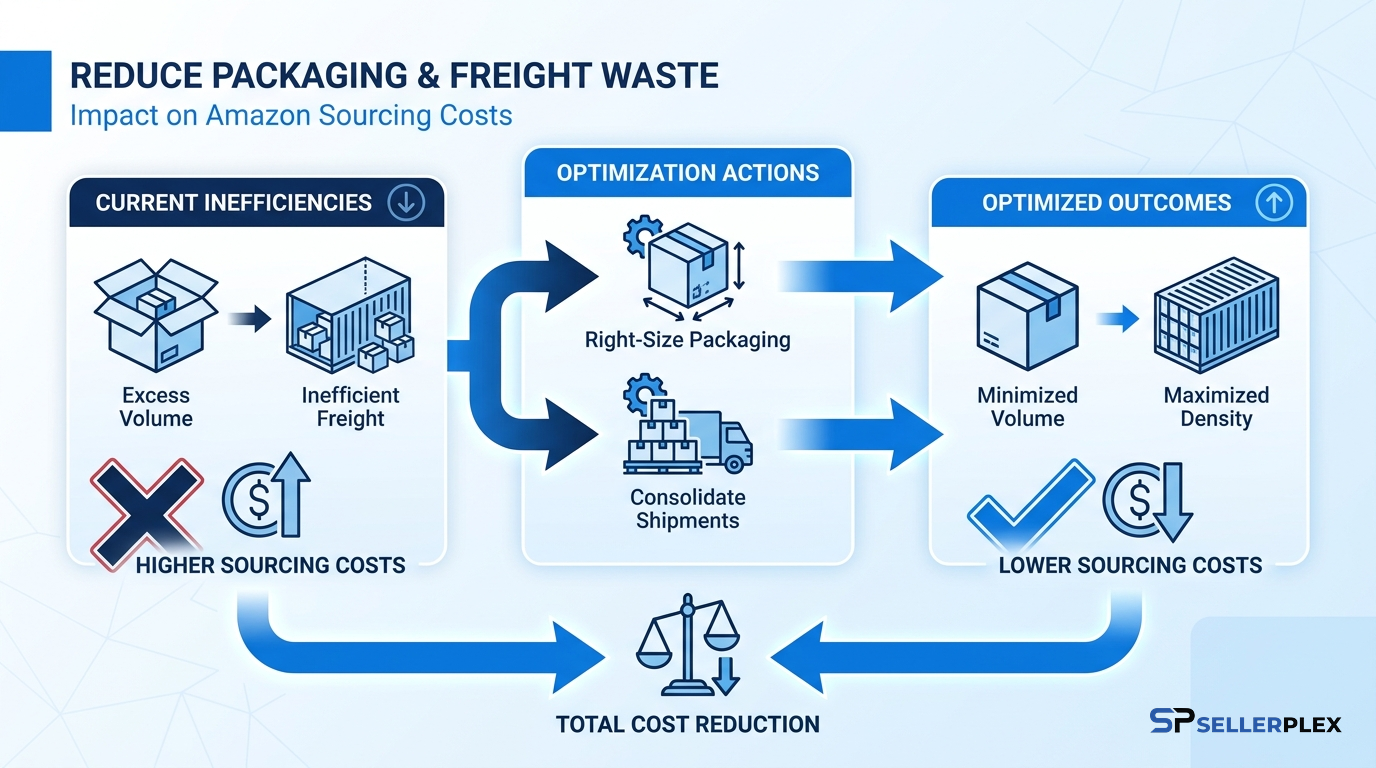
Packaging is one of the fastest ways to reduce Amazon sourcing costs because it touches manufacturing cost, freight cost, FBA receiving, storage, damage rate, and customer experience.
Start with carton-level math:
- Units per master carton
- Carton dimensions and weight
- Pallet utilization
- Container utilization
- Damage rate by packaging version
- FBA inbound placement and handling cost
Small changes matter. If a bulky insert forces a carton into a worse dimensional weight bracket, your shipping cost rises every production run. If retail packaging is overbuilt for Amazon fulfillment, you may be paying for shelf appeal that does not increase conversion.
Amazon’s FBA documentation on shipment packaging requirements is worth reviewing before changing pack design. The goal is not simply smaller packaging. The goal is compliant, protective packaging that lowers landed cost without increasing returns or negative reviews.
This is where sourcing and operations need to work together. A supplier may propose cheaper packaging that passes a quick visual review but fails under FBA handling. A 2% packaging saving is not a saving if it creates a 1-star review pattern or a returns spike.
Cut Cost Without Creating Stockouts
Get an operational review of your sourcing, freight, reorder points, and supplier process before margin leakage compounds.
Use Forecasting to Stop Emergency Buying
Emergency air freight is usually a forecasting problem disguised as a logistics problem. If your reorder point is wrong, your supplier lead time is stale, or your demand forecast ignores ad spend changes, you will keep buying expensive speed.
A stronger reorder model includes:
- 30, 60, and 90-day sales velocity
- Promotional calendar and PPC spend changes
- Supplier production lead time
- Freight lead time by lane
- Amazon receiving delay buffer
- Safety stock based on SKU volatility
- Cash available for replenishment
Our article on Amazon inventory management tips goes deeper on reorder points and stockout prevention. For sourcing cost, the key is simple: if you order too late, you negotiate from weakness.
Late orders create 3 problems at once. You lose leverage with the supplier. You pay more for expedited freight. You risk running out of stock, which can suppress organic rank and force more ad spend to recover sales velocity.
Forecast at contribution margin level
Do not replenish every SKU just because stock is low. Replenish based on contribution margin, sell-through, and strategic importance. A slow SKU with weak margin may need MOQ renegotiation or discontinuation, not another purchase order.
Amazon brands often keep too much capital trapped in long-tail inventory. That cash then becomes unavailable for the SKUs that actually deserve supplier negotiation, packaging tests, or freight consolidation.
Consolidate Suppliers Carefully
Supplier consolidation can lower cost, but it can also increase risk. Moving more SKUs to one factory may give you volume leverage, simpler communication, and better payment terms. It can also create dependency on one production calendar, one quality system, and one relationship.
Use consolidation where the supplier has real category expertise and operational consistency. Avoid giving a supplier products they are not equipped to produce just because the unit quote is attractive.
A practical supplier scorecard should include:
- On-time production rate
- Defect rate by inspection type
- Responsiveness during issue resolution
- Pricing stability
- Willingness to support cost engineering
- Documentation accuracy
- Packaging consistency
- Ability to scale without missed deadlines
Amazon Business has a useful overview of strategic sourcing, including the shift from tactical purchasing to long-term supplier value. For Amazon sellers, that value has to show up as margin, reliability, and speed.
Keep backup options alive
Even if you consolidate, keep qualified secondary suppliers for hero SKUs. Backup suppliers reduce risk and improve negotiation leverage. The key is to qualify them before you need them. Running a first production test during a stockout is how brands end up accepting poor terms and weak quality.
Value Engineer the Product, Not the Customer Experience
Value engineering means removing cost that customers do not value. It does not mean cheapening the product until returns rise.
Start by separating customer-visible value from invisible overbuilding. A supplement brand may not need premium outer cartons if the buyer values trust, compliance, and subscription reliability more than rigid packaging. A home goods brand may be able to reduce accessory count if usage data shows most customers do not use the extra parts.
Good value engineering questions include:
- Which materials affect perceived quality?
- Which components drive returns or support tickets?
- Which accessories are used by fewer than 20% of buyers?
- Can the same performance be achieved with a lower-cost material?
- Does packaging improve conversion, or just look expensive internally?
- Would the cost change affect review sentiment?
Listing data matters here. If customers complain about durability, do not cut material quality. If reviews never mention the premium insert, that insert is a cost candidate. Your sourcing decisions should connect to conversion and review data, not just supplier quotes.
For products where content, imagery, or perceived value affects pricing power, connect sourcing decisions with listing work. A cheaper product spec can destroy conversion if the listing promise no longer matches the customer experience. SellerPlex’s Amazon content creation team helps brands keep positioning, imagery, and product reality aligned when offers change.
Stop Treating Duties and Compliance as Afterthoughts
Duties, testing, labeling, and documentation can turn a good sourcing decision into a costly one. If your supplier quotes a low price but classifies products incorrectly, misses required documentation, or ships non-compliant packaging, your landed cost model is incomplete.
For each SKU, confirm:
- HS code and duty rate
- Country of origin marking
- Product safety testing requirements
- Labeling and packaging rules
- Battery, electronics, food contact, or children’s product requirements
- Importer of record responsibilities
- Documentation needed for Amazon and customs
The U.S. International Trade Commission’s Harmonized Tariff Schedule is the reference point for tariff classification. You should still work with a qualified customs broker for final classification decisions, especially when duty rates materially affect margin.
Compliance work is not exciting, but it protects cost reduction from becoming a risk transfer. A supplier discount is irrelevant if the shipment gets delayed, rejected, or reworked before it reaches Amazon.
Use Product Research to Avoid Bad Cost Structures
The cheapest sourcing cost is the one you avoid before launch. Many Amazon sellers create margin problems before the first purchase order because the product category has the wrong cost structure: heavy freight, fragile components, high return exposure, tight duty profile, or price competition that leaves no room for ads.
Before launching or expanding a product, evaluate:
- Freight cost as a percentage of expected selling price
- FBA fee sensitivity to size and weight
- Expected return rate by category
- Review standards for durability and packaging
- Price compression from competing offers
- MOQ requirements versus realistic demand
- Cash conversion cycle from deposit to sale
Our guide on choosing the right product research stack covers the research layer. The sourcing layer should pressure-test the numbers before you commit capital.
This is especially important for brands expanding from one winning SKU into adjacent products. A product can look attractive on revenue potential but weak once you factor in freight, storage, returns, and ad cost.
What Not to Cut
Some costs protect revenue. Cutting them can produce a temporary margin improvement followed by refunds, suppressed listings, bad reviews, or compliance problems.
Be careful with:
- Final random inspections on high-volume SKUs
- Material quality tied to durability or safety
- Packaging that prevents damage in FBA handling
- Supplier communication and production monitoring
- Compliance documentation
- Reorder buffers on hero SKUs
If a cost reduction increases operational variance, model the downside before approving it. A $0.20 saving per unit can disappear quickly if the defect rate moves from 1.5% to 4%, or if a top SKU loses 2 weeks of sales because production missed a deadline.
For larger catalogs, this is where a managed operating cadence matters. SellerPlex’s Amazon supply chain management service covers forecasting, supplier coordination, FBA shipment planning, freight optimization, warehouse coordination, and cost control across the chain.
A 30-Day Sourcing Cost Reduction Plan
You do not need a full procurement overhaul to make progress. Start with the SKUs where margin recovery will show up fastest.
Week 1: Build the cost map
Pull unit cost, landed cost, FBA cost, ad cost, return rate, and contribution margin for your top 20 SKUs by revenue. Flag SKUs where margin fell, freight increased, MOQ pressure rose, or stockouts forced expensive replenishment.
Week 2: Prioritize supplier conversations
Pick 3 to 5 SKUs with the largest margin opportunity. Prepare supplier-level data: order history, forecasted volume, defect rates, and target landed cost. Decide whether the ask is lower unit cost, better terms, packaging change, split shipments, or lead time improvement.
Week 3: Test operational fixes
Run a carton review, compare freight options, update reorder points, and check whether slow SKUs are absorbing cash. If a SKU needs packaging changes, test before rolling into the next major production run.
Week 4: Lock the operating rhythm
Create a recurring review for sourcing cost, inventory risk, and supplier performance. Assign clear ownership for purchase order timing, supplier follow-up, inspection review, freight booking, and Amazon inbound planning.
This cadence prevents sourcing from becoming a once-per-year negotiation. Your costs move every month. Your operating system should catch the movement before margin erosion becomes normal.
Frequently Asked Questions
What is the fastest way to reduce Amazon sourcing costs?
The fastest path is usually landed cost analysis across your top revenue SKUs. Look for freight waste, oversized packaging, outdated supplier pricing, emergency air shipments, and MOQs that force cash into slow inventory.
Should I switch suppliers to get a lower unit cost?
Not automatically. A new supplier can lower invoice cost while increasing defects, delays, inspection failures, and communication risk. Compare landed cost and operational reliability before moving production.
How often should Amazon sellers renegotiate supplier pricing?
Review key supplier terms at least twice per year, and after any meaningful change in order volume, raw material pricing, defect rate, or freight cost. High-volume SKUs deserve a standing cost review.
Can lower packaging cost hurt Amazon performance?
Yes. Cheaper packaging can increase damage, returns, and negative reviews if it does not survive FBA handling. Packaging changes should be tested against damage rate, customer experience, and fulfillment requirements.
How do I know which SKUs deserve sourcing attention first?
Prioritize SKUs with high revenue, declining contribution margin, expensive freight, repeated stockouts, rising defect rates, or large cash tied up in inventory. Do not spend the same effort on every SKU.
Where to Start
If you want to reduce Amazon sourcing costs without creating new operational risk, start with a landed cost review of your highest-revenue SKUs. Then connect supplier negotiation, packaging, forecasting, freight, and FBA planning into one operating cadence.
SellerPlex helps Amazon brands manage that cadence through hands-on supply chain management, from demand planning and supplier coordination to freight optimization, 3PL coordination, and reorder point management. The goal is not a cheaper purchase order. The goal is higher contribution margin with fewer surprises.
Ready to Grow Your Amazon Business?
Book a free strategy session with our Amazon and e-commerce specialists. No obligations, just actionable insights.
Amazon supply chain management →
Inventory planning, freight and 3PL coordination from factory to FBA, so stockouts stop costing you sales.
Want more of this in your Google results? Add SellerPlex as a preferred source.