

TL;DR: Conversion rate optimization for luxury ecommerce means removing doubt, not adding pressure. Show why the product costs what it costs, state returns and full landed cost near the buy box, and keep checkout short. Drop countdown timers and first visit discounts. Judge results by profit per session, since a 1.2 percent rate at a $900 order beats 3 percent at $40.
Table of Contents
- Why conversion rate optimization for luxury ecommerce works differently
- What is CRO for luxury brands, and how is it different?
- How do luxury online retailers improve conversion without discounting?
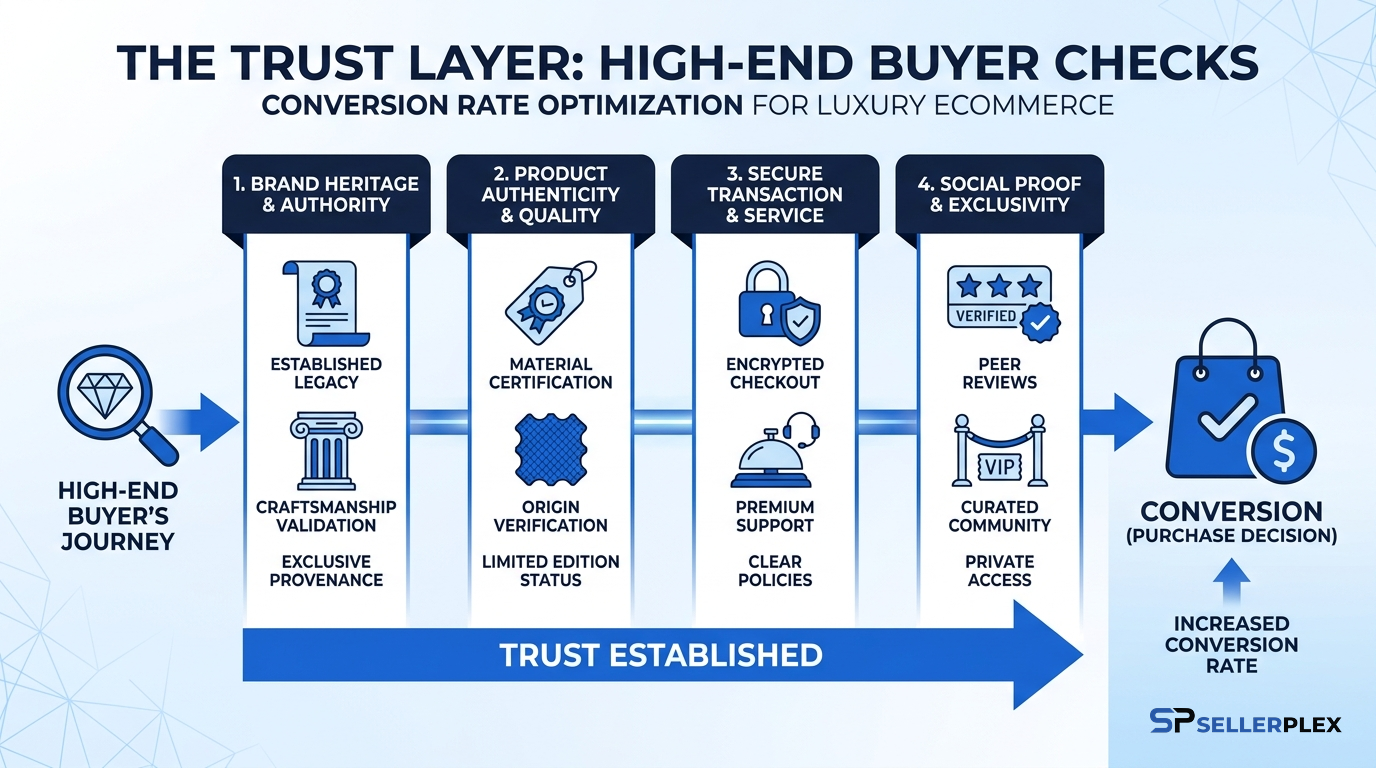
- The trust layer: what high-end buyers check before they buy
- Product pages: where luxury CRO is actually won
- Checkout: remove friction, keep the ceremony
- What backfires: the anti-playbook
- Measure profit per session, not conversion rate alone
- Where to start this week
- Frequently Asked Questions
Most CRO advice was written for volume brands. Countdown timers, exit popups, ten percent off for an email address. Run that playbook on a premium store and you train buyers to wait for discounts. Conversion rate optimization for luxury ecommerce works on a different axis: the buyer is not asking “is this cheap enough,” they are asking “can I trust this brand with a purchase I will have to justify to myself.” Answer that question well and conversion moves. Answer it with urgency banners and it drops.
This guide covers what actually lifts conversion on high-end stores, both on your own DTC site and on Amazon, where premium brands now do a meaningful share of their discovery. It also names the tactics that look like optimization but quietly erode the brand equity your margins depend on.
Why conversion rate optimization for luxury ecommerce works differently
A shopper buying a $30 kitchen gadget decides in one session. A shopper buying a $400 leather bag or a $2,000 watch typically does not. They visit multiple times, compare across channels, read the returns policy, and check who else carries the brand. Trust decides more of those sales than price does. In Baymard Institute’s cart abandonment research, 19% of US shoppers who left a cart said they did not trust the site with their card details, and 13% left over a returns policy they did not like.
That changes what “conversion” even means. On a volume store, you optimize a single session toward checkout. On a luxury store, you optimize a multi-visit journey toward a considered yes. Three practical consequences follow.
First, your baseline conversion rate will look low next to mass-market benchmarks, and that is fine. A 1.2 percent conversion rate at a $900 average order value beats a 3 percent rate at $40. Judge yourself against your own trendline, not against generic ecommerce averages.
Second, return visitors matter more than first-time visitors. If your analytics show strong first-visit traffic and weak return-visit conversion, the problem is usually memorability and follow-up, not the checkout button.
Third, every trust signal is load-bearing. A typo, a stretched product photo, or a vague shipping estimate costs you more than it would cost a discount brand, because your buyer is actively looking for reasons to believe the premium is justified.
What is CRO for luxury brands, and how is it different?
CRO for luxury brands is the work of turning more visits into sales while protecting the price the brand charges. On a volume store you remove every reason to hesitate and add reasons to hurry. On a luxury store you remove the reasons to doubt and leave out the hurry.
That shifts where the effort goes. Fewer tests on button colours and banners, more work on product proof, policies and the follow up after a first visit. The table below shows the swap in practice.
| Area | Volume store playbook | Luxury brand playbook |
|---|---|---|
| Urgency | Countdown timers, low stock alerts | Real lead times and made to order dates |
| Email capture | 10% off popup on first visit | Early access or a private preview |
| Product page | Spec bullets above the fold | The reason for the price, in concrete detail |
| Checkout | Cross sells and upsells | Full landed cost, few fields, quiet financing |
| Main metric | Conversion rate | Profit per session and repeat rate |
How do luxury online retailers improve conversion without discounting?
Luxury online retailers improve conversion without discounting by fixing the moments where a buyer loses confidence. Baymard’s data gives a clear order to work in. Of shoppers who abandoned for a reason other than just browsing, 40% blamed extra costs like shipping, tax and fees, and 12% could not see the total order cost up front.
Neither fix needs a lower price. Show duties, tax and shipping in the cart, not at the last step. Then look at trust: 19% abandoned because they did not trust the site with their card, which is a problem of visible payment brands, a clean checkout page and a known company name.
For multi brand retailers the same rules apply per brand page. Give each brand its own story block and keep the retailer’s returns promise in one short line near every buy button. Buyers who trust the store still want proof about the specific product.
The trust layer: what high-end buyers check before they buy
Before touching layouts or button colors, audit the signals a skeptical, affluent buyer looks for. In our audits of premium Amazon and DTC brands, these are the elements that most often separate stores that convert from stores that just get admired.
Provenance and craft, stated concretely
“Premium quality” is wallpaper. “Full-grain leather from a family tannery in Tuscany, cut and stitched in our own workshop” is a reason to pay more. Luxury buyers convert on specifics: materials, origin, process, and the people behind the product. If your product page cannot answer “why does this cost what it costs” in concrete nouns, no amount of layout testing will fix conversion.
Photography that survives zoom
High-end buyers zoom. They inspect stitching, clasps, texture, and finish because they cannot touch the product. Serve high-resolution imagery that holds up at full zoom, show the product in scale against a human or a familiar object, and include at least one honest detail shot of the part buyers worry about. Lifestyle photography sells the aspiration; macro photography closes the sale.
Policies written like a confident brand
Returns, shipping, warranty, and authenticity guarantees should read like they were written by a brand that expects to be trusted. Burying the returns policy or hedging it with dense conditions signals doubt. The stores we see convert best state the policy in one sentence near the buy box: what is covered, for how long, and who pays return shipping.
Product pages: where luxury CRO is actually won
The product page carries most of the conversion load, and it is where the standard playbook and the luxury playbook diverge hardest.
Write copy in the brand’s voice, not in bullet-point spec dumps. Specs belong on the page, but lower down, structured for the buyer who is already leaning yes and wants confirmation. The first screen should sell the one thing this product does for the buyer’s identity or daily life, in language a human wrote.
Reduce choices per screen. Luxury merchandising thrives on restraint. Eight cross-sell widgets, a spin-to-win popup, and a sticky discount bar tell the visitor they are in a bazaar. One clear product story, one related-products row, and generous white space tell them they are somewhere considered. Cognitive load is a conversion variable, and on premium stores it works in reverse: less pressure converts better.
On Amazon, the equivalent lever is Premium A+ Content. According to Amazon’s Brand Registry page, basic A+ Content can increase sales by up to 8% and well built Premium A+ Content by up to 20%. The strategic point is that premium modules with large imagery, comparison tables, and brand story sections are the closest thing Amazon offers to a controlled brand experience, and most premium sellers still ship basic A+ or none at all. If you want outside help, here is what a good amazon listing optimization service actually does and how to spot one that does not. If your listings are the weak link, our guide to product listing optimization that lifts both rankings and conversions walks through the full stack, from title structure to image sequencing.
Speed belongs in this section too, because slow pages read as broken and broken reads as untrustworthy. Google’s Core Web Vitals guidance sets the thresholds worth hitting: the main content should load within 2.5 seconds, the page should respond to a tap within 200 milliseconds, and layout shift should stay at 0.1 or less. Heavy imagery is non-negotiable for luxury, so invest in the engineering that keeps it fast: modern image formats, lazy loading below the fold, and a CDN close to your buyers.
Turn Browsers Into Buyers Without Discounting
Get a free audit of your listings and product pages from the team that optimizes premium Amazon brands every day.
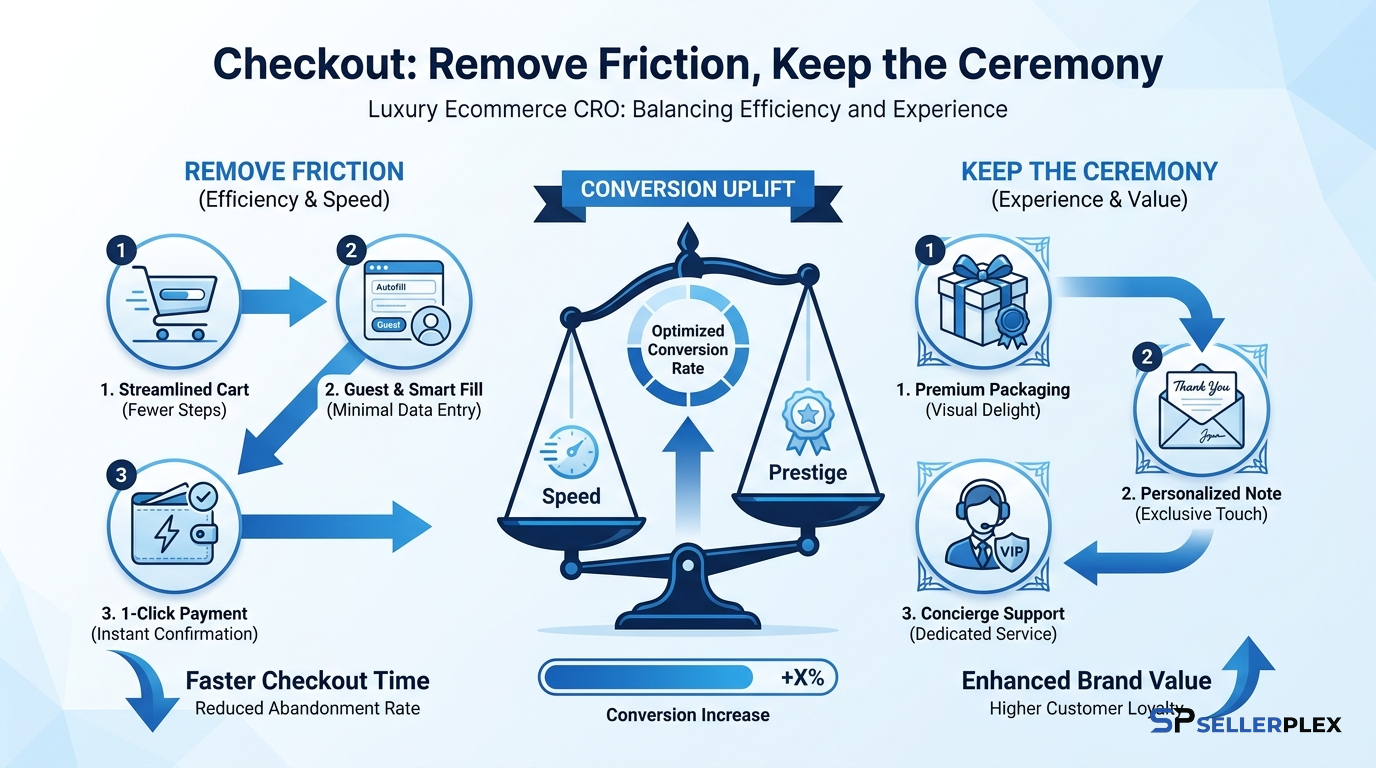
Checkout: remove friction, keep the ceremony
Cart and checkout is where abandonment concentrates. Baymard Institute puts the average documented cart abandonment rate at 70.22%. Extra costs, forced account creation (18%) and a long or complicated checkout (17%) sit among the top stated reasons. All three fixes apply directly to luxury stores, with two adjustments.
Show the full landed cost early. Affluent buyers are not price-sensitive, but they are surprise-sensitive. An unexpected duty, shipping fee, or tax at the final step breaks the trust you spent the whole session building. If you ship internationally, calculate duties at the cart, not at the doorstep.
Offer payment methods that match the basket. Digital wallets reduce typing friction on any store. For four-figure carts, financing options presented discreetly can lift completion without signaling discount culture, as long as the presentation stays quiet: a small line under the price, not a banner.
Keep guest checkout, and make the post-purchase moment part of the product. Order confirmation, packaging, and the first email set up the second purchase. Repeat buyers are where luxury unit economics get attractive, and email remains the highest-margin channel to reach them; we covered the mechanics in our piece on building repeat revenue with DTC email marketing.
What backfires: the anti-playbook
Some widely recommended CRO tactics reliably hurt premium stores. If any of these are live on your site, removing them is often the fastest win available.
Countdown timers and fake scarcity
Sophisticated buyers recognize manufactured urgency instantly, and it reframes the purchase from “considered investment” to “impulse buy,” which invites second-guessing and returns.
Discount popups on first visit
Offering ten percent off before the visitor has seen a single product anchors your brand at minus ten percent forever. If you want email capture, trade content or early access, not margin.
Aggressive cross-sells in checkout
“People also bought” belongs on the product page, not between the buyer and payment. Every added decision at checkout is a chance to defer the whole purchase.
Copying A/B test results from volume brands
A test that won for a $25 supplement brand tells you nothing about a $600 outerwear brand. Test on your own traffic, and hold tests long enough to cover your longer consideration cycle. With lower order volume, luxury stores need more patience per test, not more tests per month.
Measure profit per session, not conversion rate alone
Conversion rate is a means, not the goal. A luxury store can raise conversion and lose money: discount-driven lifts pull in one-time bargain hunters, inflate return rates, and depress repeat purchase. The metric that keeps you honest is contribution profit per session, segmented by traffic source and by new versus returning visitors.
Segmentation matters because blended numbers hide the story. Paid traffic from broad targeting will always convert below branded search. If paid sessions convert poorly, the fix may be traffic quality rather than the site; that is a targeting and bid problem, the kind of thing a managed Amazon PPC program exists to solve. And before scaling any winning variation, verify the economics at the SKU level. Our framework for measuring true SKU-level profit before you scale applies directly here: returns, payment fees, and packaging costs hit premium products differently than commodity ones.
Where to start this week
If you run a premium store and want movement in the next 30 days, sequence it like this. Pull up your top three product pages and rewrite the first screen to answer “why does this cost what it costs” in concrete specifics. Check those pages against Core Web Vitals and fix the slowest one. Walk your own checkout on a phone, note every surprise and every extra decision, and delete what you can. Then remove any urgency widgets or first-visit discount popups, and watch what four weeks of clean data tells you.
If you would rather have a team do this with you, this is core work for us. If you sell on Amazon too, read how DTC brands should choose a listing optimization agency before you hire one. SellerPlex runs conversion and content optimization for premium Amazon and DTC brands as part of full-service account management, from listing imagery and Premium A+ Content through checkout and retention flows. The starting point is a free audit: we look at your pages, your funnel data, and your unit economics, and hand you a prioritized list, whether or not you work with us.
Frequently Asked Questions
Do luxury ecommerce stores really have lower conversion rates?
Usually, yes, and it is not a problem by itself. Higher prices mean longer consideration and more research visits per purchase, so session-level conversion looks lower than mass-market benchmarks. Judge performance by profit per session and by your own trend over time, not by cross-industry averages.
Should a luxury brand ever run discounts?
Sparingly and quietly. Occasional private offers to existing customers, early access for loyal buyers, or end-of-season archive sales can work without damaging positioning. Public sitewide discounts and first-visit coupon popups train buyers to wait and anchor the brand at a lower price.
What is the single highest-impact CRO change for a premium store?
For most stores we audit, it is product page depth: zoomable photography that survives inspection, copy that justifies the price in concrete terms, and a clearly stated returns policy near the buy box. Checkout fixes matter, but buyers rarely reach checkout if the product page fails the trust test.
Does luxury CRO work the same on Amazon as on a DTC site?
The principles transfer but the levers differ. On Amazon you control the listing, imagery, Premium A+ Content, and advertising traffic quality, while checkout is fixed. On DTC you control the full journey. Premium brands selling on both should keep visual language and pricing consistent across channels, because their buyers check both.
How long should a luxury store run an A/B test?
Longer than a volume store. With fewer daily orders and a multi-visit consideration cycle, most premium stores need four to eight weeks per test to reach a trustworthy read. Running one clean test at a time beats running three underpowered ones.
Ready to Grow Your Amazon Business?
Book a free strategy session with our Amazon and e-commerce specialists. No obligations, just actionable insights.
Listing copy, A+ Content, brand stories and imagery built to rank and convert.
Want more of this in your Google results? Add SellerPlex as a preferred source.