

AI tools for amazon sellers can compress research, listing work, ad analysis, and reporting into hours instead of days. They can also create a false sense of control when the inputs are thin, the data is stale, or nobody owns the operational follow-through.
Table of Contents
That distinction matters more for a 7 or 8 figure Amazon brand than it does for a hobby seller. At scale, the goal is not to find a clever prompt or a cheaper tool subscription. The goal is to make faster decisions without creating compliance problems, margin leaks, inventory mistakes, or listings that read well but convert poorly.
The useful question is not “which AI tool is best?” It is “which parts of my Amazon operation are repeatable enough for AI, and which still need experienced human judgment?”
This guide uses that lens. It breaks down where AI can create real leverage, where sellers tend to overtrust it, and how to build a practical stack that supports profit, not just activity.
The highest-ROI AI use cases for Amazon brands
AI helps most when the task has lots of data, clear decision criteria, and repetitive analysis. It underperforms when the task needs commercial judgment, negotiation, compliance interpretation, or cross-functional accountability.
Product and market research
Product research is a natural AI use case because sellers already deal with messy inputs: reviews, price history, competitor listings, search terms, estimated demand, and supplier constraints. AI can summarize that mess quickly.
For example, a brand looking at a new variation in a competitive home category might use AI to cluster 1,000 competitor reviews into themes such as assembly complaints, missing accessories, packaging damage, unclear sizing, and warranty frustration. That is more useful than reading reviews one by one, but it is still only one input.
Use AI to speed up evidence gathering, then force the result through the same commercial filter you would use without it: landed cost, gross margin, defect risk, supplier reliability, differentiation, PPC intensity, and cash exposure.
If your team is still refining how it evaluates product and category opportunities, SellerPlex has a deeper framework on choosing the right product research stack.
Listing optimization and content workflows
Amazon’s own AI listing capabilities have moved quickly. Amazon says sellers can use generative AI to create product titles, descriptions, and attributes from short descriptions, images, or existing URLs, and its newer listing tools can suggest improvements to live listings through Enhance My Listing. Amazon’s overview of product listings with gen AI is worth reviewing because it shows where the platform itself is pushing sellers.
That does not mean brands should publish AI copy without review. Listing content is not just text. It is a conversion system that has to balance indexing, claims, imagery, brand positioning, category norms, and compliance.
A stronger workflow looks like this:
- Pull customer review themes from your own ASINs and top competitors.
- Compare those themes against your current title, bullets, A+ Content, image callouts, and backend terms.
- Use AI to draft revised copy options around proven customer language.
- Review claims, restricted terms, and category requirements before upload.
- Test the highest-impact content changes with Amazon’s Manage Your Experiments when the ASIN is eligible.
The mistake is asking AI to write “better bullets” without giving it the commercial context. A generic bullet can sound polished and still miss the buying objection that costs you 8 percentage points of conversion. SellerPlex’s guide to Amazon product listing optimization covers the broader conversion system behind that work.
For brands with many ASINs, the biggest win is process. Prioritize the ASINs with the largest sales impact, review the data, draft, approve, test, then document the result. SellerPlex’s Amazon content creation team can support that cycle when listings need more than one-off copy edits.
PPC analysis and budget decisions
AI is useful for PPC when it reduces noise. A mature Amazon ad account can have thousands of search terms, bid changes, placements, match types, budget caps, and campaign naming inconsistencies. AI can group queries, identify wasted spend patterns, summarize performance movement, and flag terms that deserve operator review.
It should not be allowed to blindly change bids without profitability context.
Take a brand with 250 active campaigns across branded, non-branded, competitor, Sponsored Brands, and defensive placements. A simple AI workflow can group search terms into intent buckets:
- High-converting exact terms that need budget protection
- Expensive discovery terms with weak conversion
- Category terms that convert only on hero SKUs
- Competitor terms that drive volume but drag blended margin
- Branded terms with strong ROAS but questionable incrementality
That grouping helps the PPC manager make decisions faster. It does not replace the manager’s job. A bid that looks inefficient inside one campaign may still protect ranking, defend a key ASIN, or support a launch timeline. We compare Amazon PPC software with a managed team in a separate guide.
If ad costs are already pressuring contribution margin, start with the economics before adding another automation layer. SellerPlex’s guide to Amazon PPC cost explains how to think about spend in context, and the Amazon PPC management team can help build a cleaner operating model around it.
Turn AI Signals Into Account Execution
Get senior operators reviewing the decisions behind your tools, from listing priorities to margin-sensitive account actions.
Inventory and supply chain planning
AI can help sellers find patterns in stockouts, sell-through, supplier lead times, transfer delays, and seasonality. That is valuable because supply chain mistakes usually show up late. By the time the dashboard turns red, the sales rank damage may already be happening.
The practical use case is exception management. Instead of asking a person to scan every SKU manually, configure AI-assisted reporting to surface issues like:
- Top sellers with less than 45 days of available inventory
- SKUs where PPC spend increased but replenishment did not
- Variations with uneven sell-through that may strand inventory
- Supplier lead times drifting beyond the forecast assumption
- FBA capacity constraints that threaten launch or promotion plans
The output should be a decision queue, not just an alert feed. For each issue, someone still needs to decide whether to raise a purchase order, reallocate stock, slow ads, change promotion timing, or accept a temporary stockout.
This is where software-only thinking breaks down. A tool can detect that a SKU is at risk. It cannot negotiate with a supplier, rebalance cash across the catalog, or understand why a retailer order should take priority over an Amazon replenishment plan. SellerPlex covers those operating decisions through Amazon supply chain management when brands need tighter control over inventory, vendors, and marketplace growth.
Account health and compliance monitoring
AI can summarize policy changes, monitor recurring support themes, draft appeal outlines, and flag unusual catalog behavior. That makes it tempting to let automation handle more of account health.
Be careful. Amazon compliance problems are not normal admin tasks. A badly framed appeal, incomplete invoice packet, or rushed catalog edit can create more damage than the original issue.
Use AI for preparation:
- Summarize the timeline of events.
- Extract the exact policy language involved.
- Compare the issue against prior support cases.
- Draft a checklist of evidence needed.
- Prepare a clean internal brief before the operator acts.
Do not use AI as the final authority on whether a claim is compliant, whether a restricted product can be listed, or how to phrase an appeal. Amazon’s policies and enforcement patterns are too consequential for unsupervised copy.
How to choose AI tools without creating stack bloat
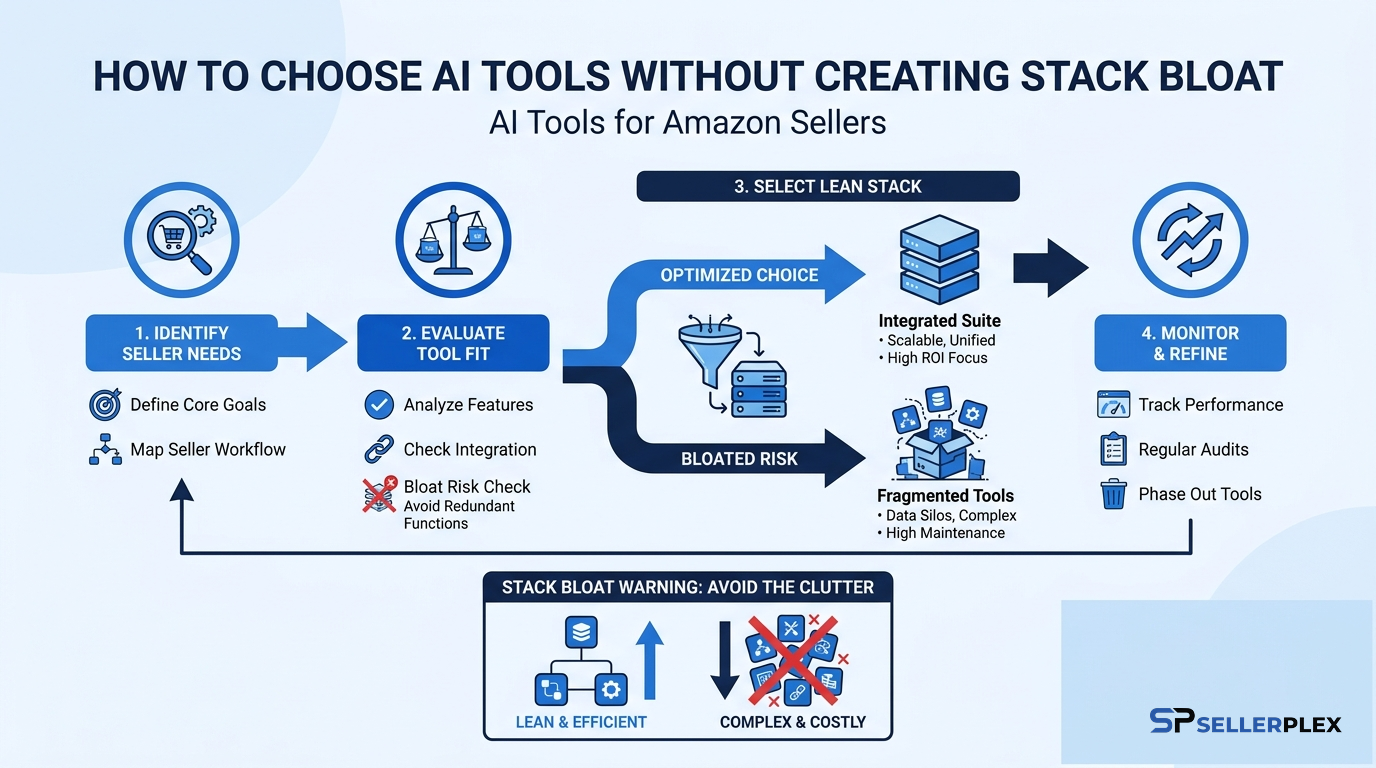
The Amazon software market already has more dashboards than most operators can use well. AI can make that worse because many tools now add summarization, chat interfaces, or “copilot” features whether the workflow needed them or not.
Choose tools by operating fit, not novelty.
1. Map the decision owner
Before buying a tool, name the person who owns the decision it supports. If nobody owns the decision, the tool will become another dashboard that gets checked when there is time.
For example:
- Listing AI belongs with the content owner, but final approval may sit with brand or compliance.
- PPC AI belongs with the media buyer, but budget tradeoffs may sit with the general manager.
- Forecasting AI belongs with operations, but purchase order timing may require finance approval.
- Review analysis belongs with content, product, and customer experience, not just one team.
A tool that crosses functions needs an operating rhythm. Otherwise the insights get interesting, then ignored.
2. Check data quality before automation
AI output is only as useful as the data feeding it. Messy SKU naming, inconsistent campaign structure, incomplete cost data, and disconnected inventory records will produce confident but weak recommendations.
A brand might ask AI to identify its best products, then discover the tool never saw true landed cost, chargebacks, returns, storage fees, or off-Amazon wholesale constraints. That is not an AI problem. It is an operating data problem.
Before automation, clean the inputs that affect profit:
- SKU and parent-child structure
- COGS, freight, duties, prep, and storage assumptions
- Campaign naming and targeting structure
- Inventory availability and lead times
- Return rates and review themes
- Buy Box and pricing history
Amazon’s Selling Partner Appstore can help you compare vetted apps, but the marketplace listing should not be your only filter. Ask how each tool ingests data, what it can change, what it cannot see, and how easy it is to audit its recommendations.
Data freshness belongs in that list too. Native Amazon reporting can lag a day or more, which is long enough to make a bid or replenishment call on stale numbers. Some analytics platforms now close that gap and go a step further: Nova Analytics refreshes Amazon data hourly and exposes it to assistants like Claude and ChatGPT through a connector, so the model reasons over current profit and ad figures instead of a week-old export. The same caveat applies. Faster data is only better data if the cost inputs behind it are right.
3. Require workflow evidence
A demo that produces a clean summary is not enough. The question is what happens after the summary.
Ask each vendor or internal builder to show:
- What specific decision the tool improves
- How recommendations are prioritized
- How false positives are handled
- Who approves changes before they affect the account
- What reporting proves the tool improved margin, conversion, or execution speed
If the answer is vague, keep the tool in research mode until it proves value. The fastest way to waste money on AI is to buy a tool that creates more review work than it removes.
80+ in-house specialists across PPC, supply chain, account management and content.
Where AI tools break for Amazon sellers
AI creates risk when it makes weak assumptions look precise. That risk is highest in 5 areas.
Compliance claims
Health, beauty, supplements, baby, food, electronics, and regulated categories need extra review. AI may produce copy that sounds persuasive but crosses a policy line. Do not let a listing tool publish claims your team has not validated.
Generic listing copy
AI often writes copy that is grammatically clean and commercially empty. It may repeat benefits the customer already assumes, miss the real buying objection, or overuse language that makes every product sound premium.
Strong listings come from customer evidence. Review mining, Q&A analysis, return reasons, support tickets, and competitor gaps should shape the copy.
PPC changes without margin context
An AI recommendation can lower ACOS while hurting ranking momentum, launch pace, or total contribution. It can also protect ROAS while starving a high-potential ASIN. Ad decisions need blended margin, lifecycle stage, stock position, and strategic priority.
Forecasting based on incomplete history
Forecasting tools can misread promotions, stockouts, seasonal spikes, listing suppressions, and one-time wholesale events. Human review matters because the forecast needs operational context, not just historical patterns.
A 30-day implementation plan
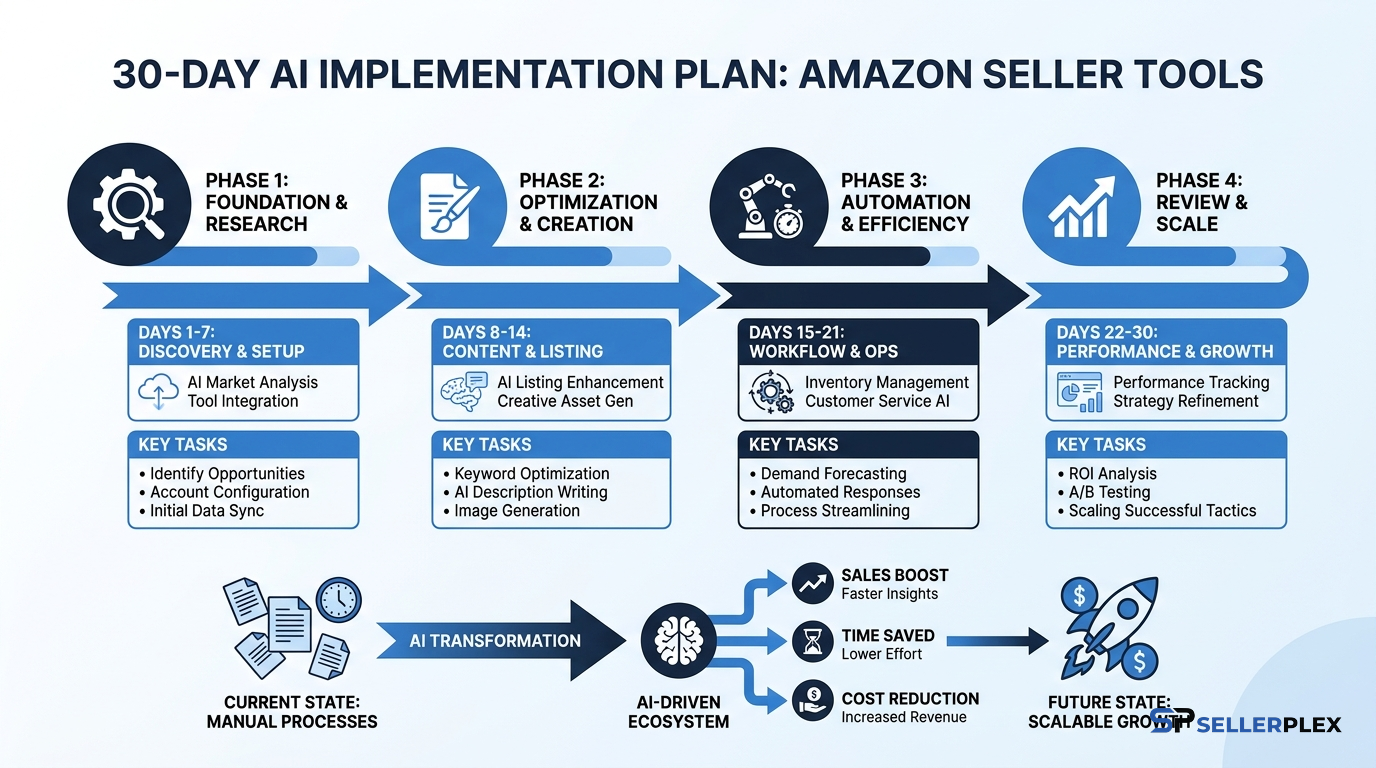
If your Amazon team wants to adopt AI without creating noise, run a 30-day implementation sprint.
Week 1: Pick 2 workflows
Choose workflows with measurable outcomes. Good candidates include listing refresh prioritization, PPC search term triage, review theme extraction, inventory risk alerts, or weekly executive reporting.
Define the metric before the tool touches the account. Examples:
- Reduce manual reporting time from 6 hours to 2 hours per week.
- Identify the top 20 listing refresh opportunities by revenue impact.
- Cut wasted spend review time while preserving conversion quality.
- Catch replenishment risks at least 30 days earlier.
Weeks 2 to 3: Clean inputs and test in advisory mode
Export the data the workflow needs and check for gaps. If COGS are missing, campaign names are inconsistent, or product families are unclear, fix the data before judging the AI output.
Do not automate changes yet. Let the tool produce recommendations, then have the owner review them. Track what was useful, wrong, incomplete, or irrelevant. The point is whether AI reduces operator workload without lowering decision quality.
Week 4: Turn the useful workflow into an SOP
Document the workflow only after it proves useful. Include who runs it, what data it uses, what decisions it supports, what approval is required, and how success is measured. If the workflow cannot be explained in one page, it may not be ready for wider rollout.
Frequently Asked Questions
What are the best ai tools for amazon sellers?
The best tools depend on the workflow you need to improve. Most scaling brands should start with listing analysis, PPC reporting, review mining, inventory alerts, and profit analytics before buying broad AI platforms.
Can AI write Amazon listings without human review?
AI can draft Amazon listings, but human review should approve claims, customer language, category rules, and conversion strategy before anything goes live. This is especially important in regulated or claim-sensitive categories.
Should Amazon sellers use AI for PPC automation?
AI is useful for PPC analysis, search term grouping, anomaly detection, and reporting. Fully automated bid changes need guardrails because campaign data rarely includes all margin, inventory, launch, and ranking context.
Can AI help with Amazon inventory planning?
AI can flag stockout risk, unusual sell-through, supplier lead-time drift, and replenishment issues. The final decision still needs operations and finance input because inventory affects cash, ranking, promotions, and vendor commitments.
How many AI tools does an Amazon brand need?
Most brands need fewer tools. Start with native Amazon tools, one or two strong analytics systems, and internal SOPs that turn AI output into accountable execution.
Where to start
Start with one expensive operating problem, not a software wish list. If stockouts are hurting rank, build an AI-assisted replenishment review. If wasted PPC spend is climbing, use AI to compress search term analysis. If conversion is weak, mine reviews and rebuild the listing workflow around customer objections.
The brands that win with AI will not be the ones with the longest tool stack. They will be the ones that connect faster analysis to disciplined execution.
If your team needs help turning AI outputs into accountable Amazon operations, SellerPlex can support the account management, content, PPC, and supply chain work behind the recommendations. Start with a focused Amazon account management review and use the tools where they actually improve profit.
Ready to Grow Your Amazon Business?
Book a free strategy session with our Amazon and e-commerce specialists. No obligations, just actionable insights.
Day-to-day Seller Central operations handled for you: catalog health, cases, compliance and buyer messages.
Want more of this in your Google results? Add SellerPlex as a preferred source.