

TL;DR: Profitable PPC optimization starts with contribution margin per SKU, since landed cost and fees decide what a product can afford to spend on ads. Give each campaign one job, review performance weekly against set thresholds, and use negative keywords as an ongoing part of margin protection. Track TACoS and inventory depth alongside ACoS.
PPC strategy optimization is not bid tinkering. For a serious Amazon brand, it is the operating system that decides which products deserve ad spend, which terms deserve scale, and which campaigns are quietly draining contribution margin.
Table of Contents
- Start with the number that actually funds growth
- Clean campaign architecture before touching bids
- Build a weekly optimization rhythm
- Optimize bids around intent, not averages
- Use negative keywords like a margin control
- Connect PPC decisions to catalog strategy
- Know when DSP belongs in the strategy
- The reporting view operators need
- What to stop doing
- A 30-day PPC strategy optimization plan
That distinction matters because Amazon ads can make revenue look healthy while profit gets worse. A brand doing $450,000 a month can still have an ad account full of loose match types, duplicate search terms, budget starvation, and campaigns that push ACoS down while total advertising cost of sales moves in the wrong direction.
The fix is not a bigger list of keywords. The fix is a cleaner decision model.
This guide is for operators who already know what Sponsored Products are. The question is how to turn Amazon PPC into a controlled growth lever instead of a weekly bid spreadsheet.
Start with the number that actually funds growth
Most PPC accounts are managed around ACoS because it is visible, familiar, and easy to explain. That does not make it the right primary metric.
ACoS tells you how efficiently ad-attributed sales were generated. It does not tell you whether advertising is growing the whole business, protecting organic rank, or masking weak profitability.
For optimization, use three layers:
Contribution margin by SKU
Before you change campaigns, calculate what each SKU can afford to spend. Use landed cost, Amazon referral fees, FBA fees, storage pressure, discounting, returns, and any agency or operational cost you allocate at SKU level.
A hero SKU with 38% gross margin and stable supply can support a different PPC target than a bulky product with 19% margin and seasonal storage fees. Treating both with the same ACoS target is how accounts drift into false efficiency.
If your team does not have SKU-level profit visibility yet, read our breakdown of Amazon seller profit analytics before scaling spend. PPC optimization without profit data usually rewards the loudest revenue line, not the best business outcome.
TACoS trend
TACoS connects ad spend to total sales. It shows whether paid traffic is helping the broader account, not just converting inside the ad console.
A temporary ACoS increase can be acceptable if TACoS is stable or declining while organic rank improves. A low ACoS account can still be unhealthy if total sales are flat and ad spend keeps doing the same work every month.
Cash cycle and inventory depth
Amazon PPC should not be scaled in isolation from inventory. If a SKU has 24 days of cover and replenishment is 50 days out, aggressive ad growth can create a stockout that erases ranking gains. If a slow-moving SKU is tying up cash, controlled advertising may be useful even at a higher ACoS.
This is where PPC stops being a channel task and becomes account management. Your ad budget has to follow the same operating priorities as the rest of the business.
Clean campaign architecture before touching bids
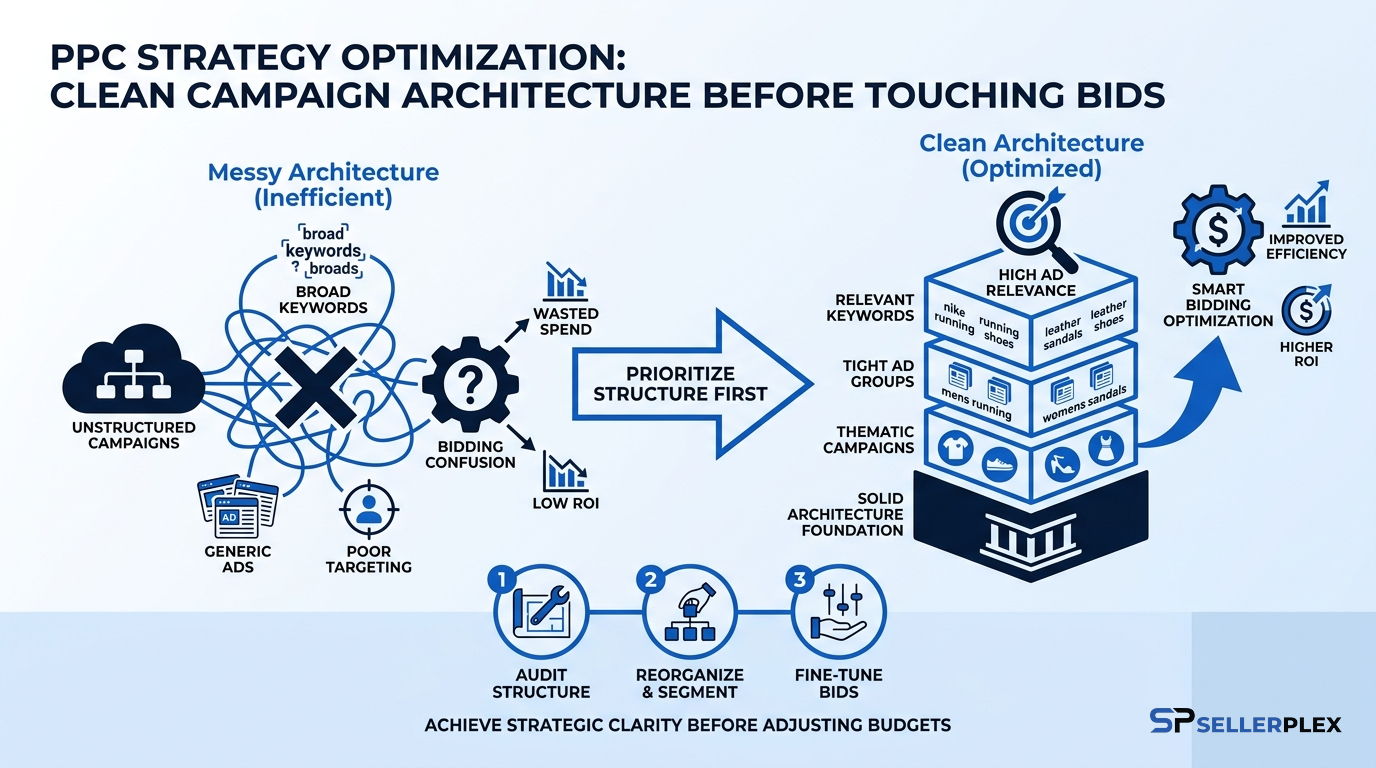
Bid changes are the visible part of PPC strategy optimization. Structure is the part that determines whether those bid changes mean anything.
A messy account usually has the same failure pattern: broad, phrase, exact, auto, branded, competitor, and product targeting all mixed across campaigns created months apart. Search terms appear in multiple places. Budgets run out before the strongest campaigns get clean data. Negative keywords are applied inconsistently.
Before optimizing performance, rebuild control.
Separate campaigns by job
Each campaign should have a defined role:
- Discovery campaigns find search terms and ASIN targets.
- Exact match campaigns scale proven terms.
- Defensive campaigns protect branded demand and product detail pages.
- Product targeting campaigns attack substitute products or defend your own catalog.
- Sponsored Brands campaigns support category visibility and brand search.
- Sponsored Display campaigns retarget and expand reach when the economics justify it.
Amazon’s own Sponsored Products documentation explains the available ad type, but it will not decide how your account should be structured. That decision has to come from margin, catalog maturity, and growth goals.
Isolate branded and non-branded spend
Blended reporting hides the truth. Branded campaigns often look efficient because the customer already knew you. Non-branded campaigns carry acquisition work and usually cost more.
If those are blended, you can convince yourself the account is efficient while prospecting is underperforming. Keep branded, category, competitor, and defensive activity separate so budget decisions are based on the job each campaign is doing.
Stop search term overlap
When the same query runs in multiple campaigns, Amazon decides where the auction happens. You lose clean readouts and often bid against yourself across match types.
Move proven search terms into exact match campaigns, then add negatives in discovery campaigns where appropriate. This does not mean choking discovery. It means giving each term one primary home once it has enough data.
Build a weekly optimization rhythm
Many brands manage PPC reactively. A bad week triggers bid cuts. A good week triggers budget increases. The account never gets a consistent operating cadence.
Weekly optimization should answer 5 questions:
- Which campaigns ran out of budget before demand ran out?
- Which search terms spent meaningfully without converting?
- Which converting terms deserve isolation or higher bids?
- Which SKUs should not receive more traffic because of margin or inventory limits?
- Which products need listing or pricing work before more ad spend makes sense?
The last question is the one many PPC audits miss. Ads cannot fix a weak retail page. If click-through rate is acceptable but conversion rate lags the category, the listing may need stronger images, offer clarity, review strategy, or content work. That is where PPC connects directly with product listing optimization support.
Use thresholds, not gut feel
Set decision thresholds before reviewing data. For example:
- Search terms with 15 to 20 clicks and no orders move to review.
- Terms above target ACoS with enough sales history get bid reductions.
- Exact terms below target ACoS with room in budget get controlled bid increases.
- Campaigns with strong conversion but limited budget get budget reallocation before new spend is added.
Your thresholds should vary by price point and conversion rate. A $22 replenishable product reaches decision data faster than a $180 consideration purchase.
Amazon’s campaign budget rules can help automate budget changes, but automation should follow your economics. Rules based on ad metrics alone can scale the wrong products.
Turn PPC Spend Into Profit Control
Get a clear read on campaign structure, wasted spend, and the margin leaks inside your Amazon ad account.
Optimize bids around intent, not averages
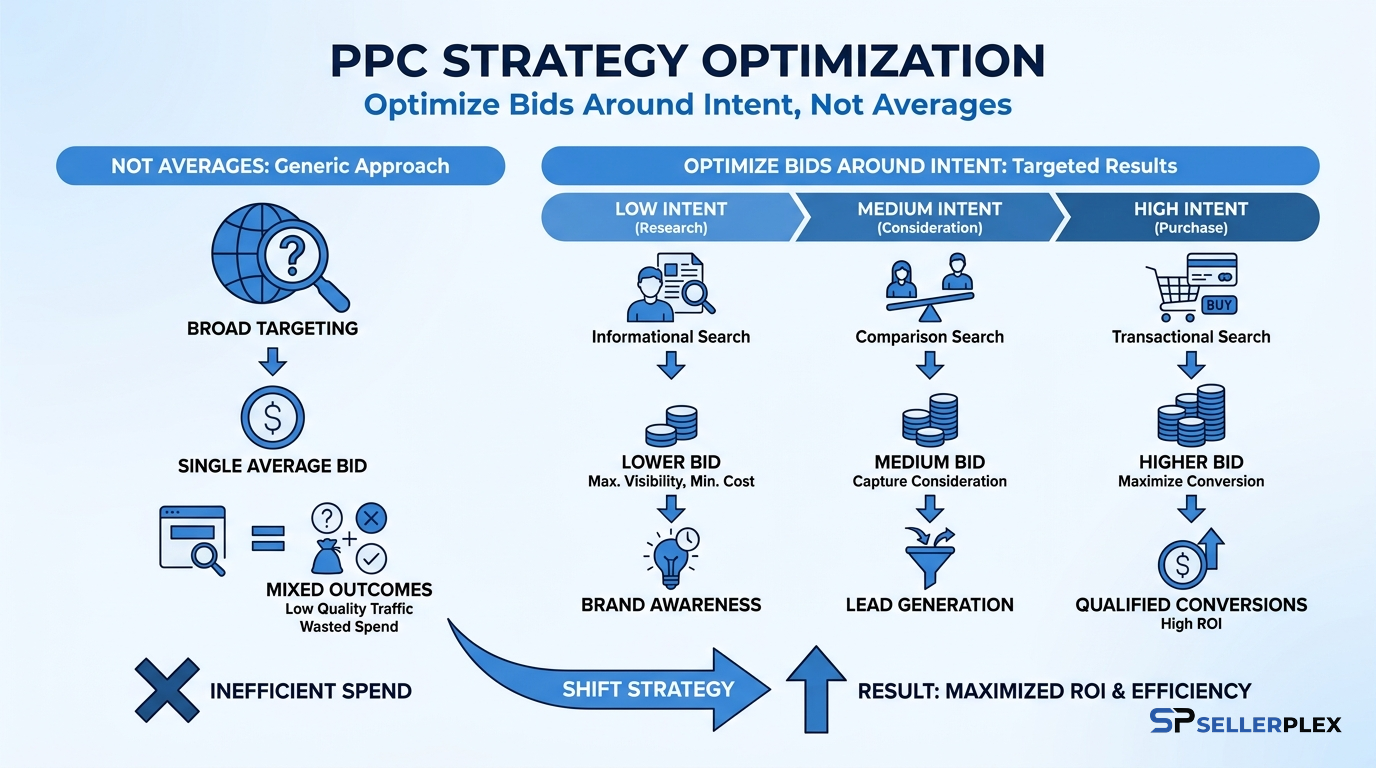
Average ACoS creates average decisions. The stronger approach is to segment search terms by intent and business value.
High-intent category terms often deserve aggressive testing because they reveal purchase demand. Long-tail terms can be efficient but may not create enough volume. Branded terms protect demand but should not consume the reporting spotlight. Competitor terms can work, but only when the product, reviews, price, and offer can carry the click.
Match bid pressure to term maturity
Discovery terms need enough bid to gather data, but not so much that they drain budget before converting. Exact match winners need enough budget and bid pressure to compete consistently. Defensive terms should be efficient, but not neglected if competitors are entering your product pages or brand results.
For mature terms, look beyond the last 7 days. Use 30-day and 60-day patterns to avoid overreacting to normal volatility. For newer tests, review click depth and spend limits so weak terms do not quietly run for weeks.
Treat placement as a separate lever
Top of search can be powerful, especially for proven exact terms. It can also be expensive. Product pages may convert well for defensive or comparison-driven products. Rest of search can deliver cheaper clicks but weaker intent.
Do not apply placement multipliers because a campaign is profitable overall. Apply them when the placement data proves it earns the right job. A campaign can have a healthy blended ACoS while one placement is carrying the whole result.
Use negative keywords like a margin control
Negative keywords are not cleanup work. They are one of the strongest levers for protecting budget quality.
Search term reports usually show the same patterns:
- Informational queries that do not convert.
- Adjacent category terms that attract the wrong buyer.
- Size, material, or use-case mismatches.
- Competitor terms where your offer cannot win.
- Branded queries that belong in a different campaign.
Do not blindly negate every non-converting term after a small sample. Expensive products need more patience. New products need room to learn. The right approach is to combine click volume, spend, relevance, and conversion history.
A useful rule: if the term would not make sense as an exact campaign even if it converted once, it probably deserves a negative.
Connect PPC decisions to catalog strategy
Amazon ad accounts often fail because the PPC manager is optimizing campaigns while the catalog is sending different signals.
A product may have strong search demand but poor contribution margin. Another may convert well but be close to stockout. A third may have a high ACoS because the listing is underbuilt, not because the traffic is bad.
Segment SKUs by role
Assign each advertised product to a role:
- Scale SKUs: strong margin, reliable stock, proven conversion.
- Rank-build SKUs: strategic keywords, acceptable short-term inefficiency.
- Defense SKUs: branded protection or catalog shielding.
- Cash-release SKUs: controlled spend to move inventory.
- Pause or repair SKUs: weak economics, poor conversion, or operational constraints.
This segmentation prevents one-size-fits-all optimization. It also makes budget discussions easier because every dollar has a business reason.
Brands that are scaling across multiple SKUs should pair PPC with broader . Advertising decisions get sharper when pricing, inventory, listing quality, and reporting are managed together.
Watch supply chain before you scale winners
PPC can create demand faster than operations can support it. If your top campaign is pushing a SKU toward stockout, every extra sale may create a future ranking problem.
This is why SellerPlex treats advertising, account operations, and supply chain as connected systems. For brands with recurring inventory pressure, Amazon supply chain support can matter as much as bid optimization.
Know when DSP belongs in the strategy
Sponsored Products and Sponsored Brands usually come first because they capture in-market demand. Amazon DSP belongs later, when the brand has enough conversion data, audience clarity, and budget discipline to use programmatic reach properly.
DSP can support retargeting, competitor conquesting, and upper-funnel awareness, but it should not be used to hide weak Sponsored Ads fundamentals. If campaign structure, search term control, and SKU economics are messy, DSP will usually amplify the mess.
For a deeper breakdown, see our guide to Amazon DSP advertising. The short version: use DSP when you have a clear audience, a measured funnel, and a reason to expand beyond search demand.
Amazon’s DSP overview is useful for understanding the channel, but your internal decision should be based on whether incremental reach can be measured against profit and pipeline goals.
The reporting view operators need
A strong PPC report should help you make decisions, not admire charts.
At minimum, weekly reporting should show:
- Spend, ad sales, ACoS, TACoS, CPC, conversion rate, and total sales by SKU.
- Campaign performance by role, not just by name.
- Search term winners and waste.
- Budget-limited campaigns with room to scale.
- SKU constraints that affect advertising decisions.
- Actions taken and expected impact.
The report should also separate performance by branded, non-branded, category, competitor, defensive, and retargeting activity. Without that segmentation, you cannot tell whether growth came from new demand or from harvesting existing brand traffic.
Benchmarks are useful only with context
Benchmarks can help spot outliers, but they should not become the target. A beauty product, a replenishable supplement, and a premium home goods SKU can all have different acceptable ACoS ranges.
Use benchmarks to ask better questions. If your CPC is materially above the category norm, inspect relevance, placement, and competition. If conversion rate trails the market, review the listing and offer. If TACoS is rising while ACoS is stable, ads may be replacing organic momentum instead of building it.
Our Amazon PPC benchmarks article gives useful reference points, but the right target is still the one your margin structure can support.
What to stop doing
The fastest improvements often come from removing bad habits, not adding more complexity.
Stop optimizing every campaign the same way. A branded defense campaign and a category acquisition campaign should not be judged by identical targets.
Stop raising budgets before cleaning search terms. More spend on a leaky structure compounds waste.
Stop cutting bids on every high-ACoS term without checking its role. Some terms are expensive because they are ranking investments or category-entry points.
Stop letting out-of-stock risk sit outside the PPC conversation. Stockouts can erase the value created by profitable campaigns.
Stop reporting only ad-console revenue. Total sales, margin, and operational readiness decide whether PPC is actually working.
A 30-day PPC strategy optimization plan
If your account is under control but underperforming, use the next 30 days to rebuild around decisions.
Week 1: Economics and structure
Map contribution margin by SKU, current inventory cover, and target ACoS range. Label campaigns by role and separate branded from non-branded activity. Identify duplicate search term paths and budget-limited winners.
Week 2: Search term cleanup
Move proven terms into exact campaigns. Add negatives where search intent is clearly wrong. Keep discovery open where the account still needs learning, but stop letting irrelevant terms spend without a decision threshold.
Week 3: Bid and budget reallocation
Shift spend toward SKUs with strong margin, stock depth, and conversion. Increase bids selectively on exact terms that can scale. Reduce bids where spend is outpacing the business value of the term.
Week 4: Retail readiness and reporting
Flag listings where conversion rate blocks PPC efficiency. Review images, content, offer, price, and reviews before scaling traffic. Build a weekly reporting view that connects campaigns to SKU-level profit and TACoS.
This sequence is not glamorous. It works because it gives every optimization a reason.
Frequently Asked Questions
What is PPC strategy optimization on Amazon?
PPC strategy optimization on Amazon is the process of improving campaign structure, bids, budgets, search terms, placements, and SKU-level spend decisions so advertising supports profitable total account growth.
Is ACoS or TACoS more important for PPC optimization?
Both matter, but they answer different questions. ACoS measures ad-attributed efficiency. TACoS shows how ad spend relates to total sales and whether PPC is helping the broader account grow.
How often should Amazon PPC campaigns be optimized?
Most active accounts need weekly optimization. High-spend accounts may need more frequent budget and search term checks, but strategic changes should still be judged with enough data to avoid overreacting.
When should a brand increase Amazon PPC budget?
Increase budget when campaigns are constrained, conversion is proven, SKU margin supports the spend, and inventory can handle the extra demand. Budget increases should not be used to compensate for weak structure.
Can PPC optimization fix a low-converting listing?
No. PPC can send more traffic, but it cannot fully solve weak images, unclear positioning, poor reviews, bad pricing, or low retail readiness. Listing work should happen before aggressive ad scaling.
Where to start
The best PPC strategy optimization work starts with one question: which ad dollars are creating profitable growth, and which are only creating activity?
If your team cannot answer that by SKU, campaign role, and search term, start with structure and reporting before chasing new tactics. Clean architecture, profit-aware targets, negative keyword discipline, and inventory-aware budget decisions will outperform random bid changes almost every time.
SellerPlex helps Amazon brands manage PPC as part of the full operating system: Sponsored Products, Sponsored Brands, Sponsored Display, DSP, keyword research, bid optimization, budget allocation, search term analysis, negative keyword management, and weekly performance reporting tied to action.
If you want a sharper read on wasted spend and profitable scale opportunities, start with a free Amazon PPC audit.
Ready to Grow Your Amazon Business?
Book a free strategy session with our Amazon and e-commerce specialists. No obligations, just actionable insights.
Campaign structure, bids and search-term hygiene, run by operators who have spent millions on Amazon ads.
Want more of this in your Google results? Add SellerPlex as a preferred source.