Amazon Pay Per Click: What a Click Costs and Earns
TL;DR: Amazon pay per click means you are charged only when a shopper clicks your ad, at a price set by an auction that your bid caps. Across 38 US accounts SellerPlex manages, the median click cost $1.07 in the first half of 2026 and 8.3% of clicks became orders. That puts the typical ad order at about $13, so your margin decides whether a click pays.
Table of Contents
Most explanations of Amazon's ad model stop at "you pay when someone clicks." That part is true and not very useful. What a seller needs is the price of a click, the value of a click, and the gap between them. This page works through all of it with numbers from accounts we run and from Amazon's own documentation.
How does Amazon pay per click charge you?
Amazon charges you when a shopper clicks your ad, and the amount comes out of an auction. Impressions cost nothing. According to the Amazon Ads FAQ, Sponsored Products, Sponsored Brands and display ads all run on this cost-per-click model.
Your bid is a ceiling. Amazon's guide to cost per click says the final CPC "is usually determined by an auction and is based on your adjusted bid plus additional factors." The same guide defines the maximum charge as your base bid plus any adjustments from settings such as dynamic bidding.
That last part catches people out. If you raise bids for top-of-search placement or let dynamic bidding push them up, your real ceiling sits above the bid you typed.
What decides the final price
Three things move the number you pay. Other brands bidding on the same search term set the floor you have to beat. Relevance counts too, since the auction weighs more than bid alone. Placement adds the rest: Amazon notes that more visible slots and more in-demand keywords cost more.
You control only your bid, your adjustments and how relevant your listing is to the search. The competition changes every week whether you touch the account or not.
What does one click cost on Amazon right now?
A click cost a median of $1.07 across all campaign types in the first half of 2026. That figure comes from our Amazon PPC benchmarks, built from 38 US Amazon.com accounts under SellerPlex management. Together they spent about $5.2 million on ads over the six months.
The middle half of those accounts paid between $0.75 and $1.85 per click. The cheapest tenth paid under $0.45 and the most expensive tenth paid over $3.00. Category competition explains most of that spread.
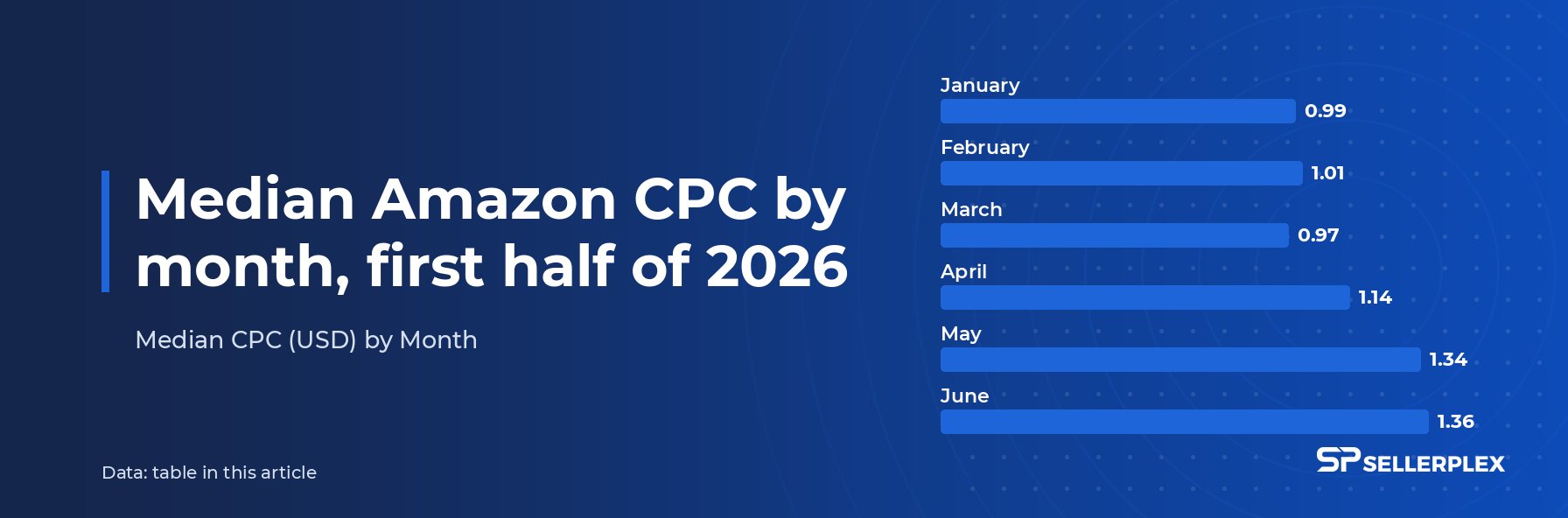
The price also moved a lot during the year:
Median Amazon CPC by month, first half of 2026
| Month | Median CPC (USD) | Accounts |
|---|---|---|
| January | 0.99 | 37 |
| February | 1.01 | 36 |
| March | 0.97 | 36 |
| April | 1.14 | 35 |
| May | 1.34 | 36 |
| June | 1.36 | 34 |
From January to June the median rose 37%. A seller who kept the same monthly budget bought roughly 27% fewer clicks by June. Nothing in their account changed. The auction around them did.
What is a click worth to your business?
A click is worth your profit per order multiplied by the share of clicks that turn into orders. That second number, the conversion rate, matters as much as the click price.
In our managed accounts the median conversion rate was 8.3%. It was the steadiest metric we tracked, holding between 7.6% and 8.8% every month while click prices climbed. So the cost of winning one order through ads is simply CPC divided by conversion rate.
Ad cost per order at different click prices
| Click price (USD) | Conversion rate | Ad cost per order (USD) | ACoS at a $37 order |
|---|---|---|---|
| 0.75 | 8.3% | 9.04 | 24% |
| 1.07 | 8.3% | 12.89 | 35% |
| 1.85 | 8.3% | 22.29 | 60% |
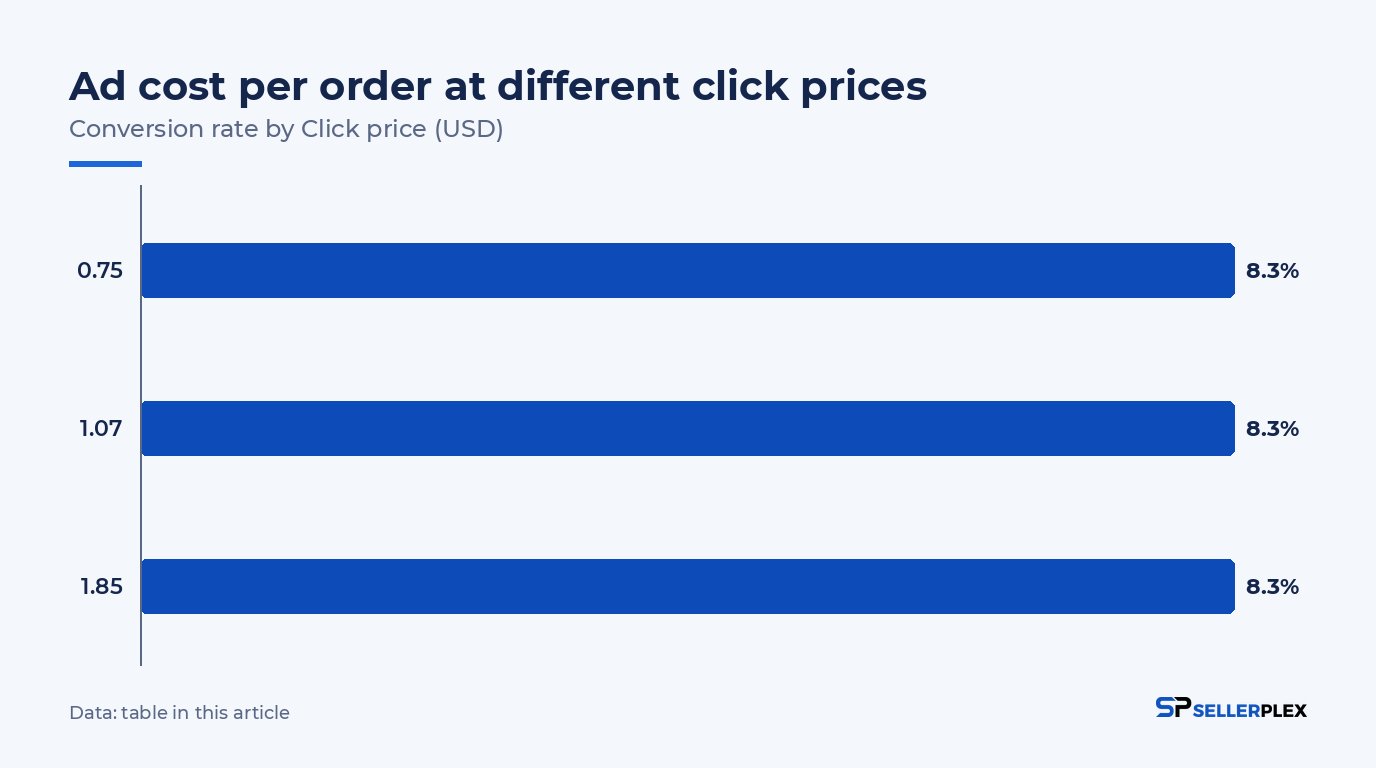
The $37 order value is the median ad-attributed order in the same dataset. Amazon's ACoS guide defines ACoS as ad spend divided by ad revenue, which is what the last column shows.
Look at the bottom row. A seller paying $1.85 per click needs a 60% margin before ads just to break even on that sale. Very few physical products have that.
Working out your break-even bid
Your break-even CPC is order value times margin before ads times conversion rate. Take a product with a $37 average order and a 35% margin after Amazon fees and landed cost. Each order leaves $12.95 before advertising. At an 8.3% conversion rate, a click is worth about $1.07.
Bid above that on a mature product and every ad sale loses money. Bid well below it and you leave profitable volume to competitors. Run the sum per product, because a catalog with mixed margins has a different break-even bid for every SKU.
There are good reasons to pay above break-even for a while. A launch, a rank push before peak season or a defensive bid on your own brand name can all justify it. The point is to decide that on purpose, with an end date.
Find out what your clicks are actually worth
We review your bids against each product's real margin and show you where spend runs above break-even.
Talk to a StrategistHow does your daily budget really spend?
Your daily budget is a monthly figure divided by the calendar, and Amazon does not pace it through the day. The Amazon Ads FAQ gives the example directly: a $100 daily budget can buy up to $3,100 of clicks in a 31-day month.
The same answer warns that a small daily budget "could be spent in a few minutes" when many shoppers search at once. The minimum daily budget for Sponsored Products is $1.
Two practical effects follow from that. A campaign that runs out of budget by mid-morning shows no ads for the rest of that day. And one day can spend well above the daily figure while the month stays inside the total.
We set budgets per campaign from the expected clicks, never as one round number. A discovery campaign on low bids needs far less money than an exact-match campaign fighting for top of search. When a winning campaign keeps capping out, we move money to it from campaigns that are not producing orders.
Where Amazon PPC spend leaks
Most wasted pay per click spend sits in a handful of places we check in every account we take on. None of them show up as an error in the console.
Search terms with clicks and no orders
Auto and broad campaigns match your ad to searches you never chose. Some of those convert well. Others collect 20 or 30 clicks without a single order. At a $1.07 click, 30 empty clicks is $32 gone on one term. Multiply that by a few hundred terms and it becomes a monthly line item.
We review search terms weekly, add the losers as negatives and move converting terms into their own exact-match campaigns. Our breakdown of where ad budget quietly leaks goes through the other common holes.
One target for the whole catalog
A single ACoS target across products with different margins scales the wrong ones. Your 20% margin accessory and your 45% margin hero product cannot share a bid rule. Set the target from each product's break-even sum above.
Ignoring the account-level number
ACoS only covers sales that ads touched. In our dataset ads drove a median 41% of total sales, and the median account ran a 15% TACoS, which is ad spend divided by all sales. If TACoS rises while total sales stay flat, ads are replacing organic sales instead of adding to them.
Is Amazon pay per click worth it for your brand?
It is worth it when the click price sits below what a click earns you, and it stops being worth it on the products where it does not. For most brands we manage, ads are now the main source of paid traffic, so switching them off is rarely the cheap option it looks like.
The median account in our benchmarks ran a 38% ACoS and a 2.6 return on ad spend. Half of those accounts landed between 25% and 53% ACoS. That spread is normal. A launch at 55% can be a good result, while a five-year-old bestseller at 55% usually means the bids have drifted.
If you are still choosing which ad type to start with, our guide to Amazon PPC advertising ad types and costs compares Sponsored Products, Sponsored Brands and display ads side by side.
If you want help with this
Start with your own break-even CPC per product. Pull 60 days of data, divide spend by orders for each product, and compare the result with the margin each order leaves you. Any product where the ad cost per order is higher than that margin is where to look first.
If you would rather have a team do this daily, our Amazon PPC management service team handles bids, placements and weekly search-term reviews, with a senior strategist on every account. You can also see how we approach PPC strategy optimization for profit.
Frequently Asked Questions
How much does Amazon charge per click?
There is no fixed price. Each click is priced by an auction, and your bid sets the most you can pay, plus any adjustments you switched on. Across 38 US accounts SellerPlex manages, the median click cost $1.07 in the first half of 2026, with most accounts paying between $0.75 and $1.85.
Do you pay for impressions on Amazon ads?
Not on the cost-per-click model. Amazon's own FAQ says ad impressions are free and you are charged only when a shopper clicks. Sponsored Products, Sponsored Brands and display ads all use that model. Audio ads are the exception Amazon names, sold per 1,000 impressions, so check the billing type of any newer format.
Why did I pay more than my bid?
Your bid is only the base. Placement adjustments for top of search or product pages and dynamic bidding can raise the price above it. Amazon counts all of those in your maximum cost per click. Check the campaign's bidding strategy and placement settings before you lower the keyword bid itself.
What is a good conversion rate for Amazon ads?
In our managed accounts, the median was 8.3% of ad clicks turning into orders in the first half of 2026. The middle half of accounts ran between 5.4% and 11.1%. A rate well below 5% usually points to the listing, the price or the reviews before it points to the ads.
Next step: Talk to a Strategist. Book a free strategy session with our Amazon and e-commerce specialists. No obligations, just actionable insights.