

TL;DR: Sponsored ads and Amazon DSP are not an either-or choice. Sponsored ads capture demand already in search and should keep most of the budget as long as it converts, since those sales also feed organic rank the way DSP cannot. DSP earns its place, usually needing $10,000 to $15,000 a month and 60 to 90 days, once sponsored is efficient and you have audiences keywords cannot reach.
Most teams asking about Amazon DSP vs sponsored ads are really asking a different question: we’ve maxed out sponsored, where does the next dollar go? The answer is rarely “either / or.” Sponsored ads and DSP solve different problems on the same platform, and the brands that grow fastest run them as one system, not two checkboxes. The trouble is that DSP gets pitched like a magic awareness lever, and sponsored gets treated like a slot machine. Neither is true.
Table of Contents
This is a practical comparison for sellers already spending real money on Amazon, written from what we see managing seven and eight figure ad budgets day to day. By the end you should know which one to start with, which one to add when, and the specific places where DSP either pays for itself in 90 days or quietly burns budget that should have gone to Sponsored Products.
The 30-second version
Sponsored ads (Sponsored Products, Sponsored Brands, Sponsored Display) live inside Amazon search and product pages. They’re keyword-driven, auction-priced, and bought on a CPC basis through your Seller Central or Vendor Central ad console. Anyone with a Professional Seller account can run them.
Amazon DSP (Demand-Side Platform) is Amazon’s programmatic display and video buying tool. It runs ads across Amazon properties (homepage, Fire TV, Twitch, IMDb) and across the open web on Amazon-owned and third-party inventory. It’s bought on a CPM basis, uses Amazon’s first-party shopping signals to target audiences, and historically required a managed-service relationship or a minimum self-serve commitment, often $35,000 or more per quarter depending on the AM you’re working with.
In short: sponsored ads capture demand that’s already there. DSP creates and re-captures demand outside the search bar. Both can drive sales, but the unit economics behind each are very different.
Where each format actually wins
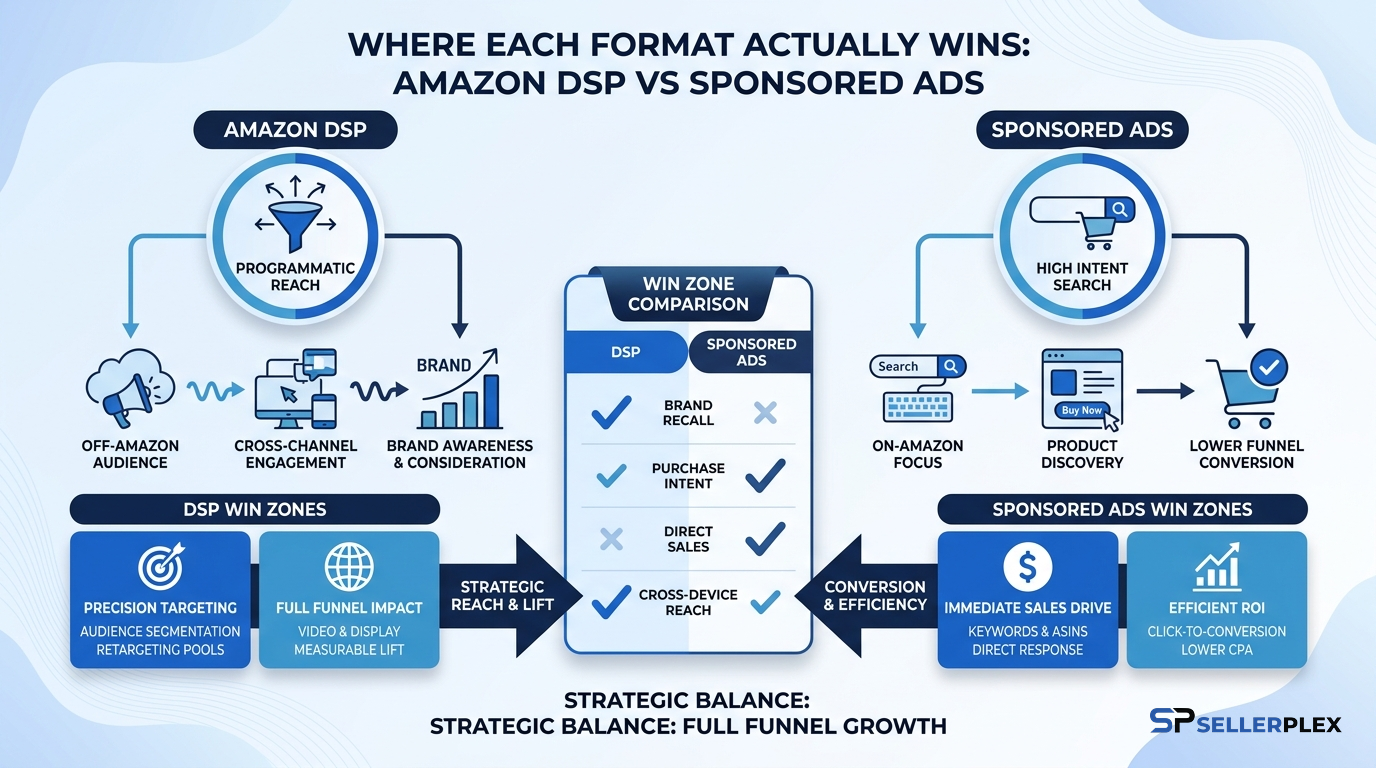
Sponsored ads: the demand-capture layer
If a shopper types “stainless steel travel mug 16oz” into the Amazon search bar, Sponsored Products is the format that puts you in front of them. The intent is high, the click-to-purchase distance is short, and conversion rates on a well-optimized listing routinely run 10 to 20 percent on branded terms and 5 to 10 percent on category terms.
This is also where most sellers should spend the majority of their ad budget for as long as the math works. We’ve seen brands try to “graduate” from Sponsored Products to DSP and watch their efficient sales evaporate. The right frame is: Sponsored Products is the floor of your ad strategy, not a starter format you outgrow.
A few realities that don’t get said enough:
- Sponsored Products is the only format with a direct line to the Best Sellers Rank flywheel. Sales velocity from these ads feeds organic rank, which lowers your TACoS over time. DSP does not move BSR the same way.
- Sponsored Brands lets you defend your branded search results page and showcase a product family. It’s underused. If you’re spending $50k+ per month on Sponsored Products and not running a Sponsored Brands video on your top three brand terms, you’re leaving margin on the table.
- Sponsored Display has quietly become the most interesting of the three. It targets audiences and products both on and off Amazon, but it’s still bought CPC inside the regular ad console, with no minimum spend. For most brands under $5M revenue, Sponsored Display is the right “DSP-style” lever before real DSP makes sense.
Amazon DSP: the demand-creation and reclaim layer
DSP earns its place once you’ve hit two milestones: you’re already converting paid traffic profitably on Amazon, and you can identify audiences that aren’t reachable through keywords alone.
The strongest DSP use cases we see in practice:
- Retargeting product page viewers who didn’t buy. Amazon’s first-party data on shopper behavior is the moat. A “viewed your product, did not purchase in the last 30 days” audience reliably runs 3x to 5x ROAS for brands with $40+ AOVs.
- Cross-selling to existing customers. If someone bought your travel mug, DSP can serve them an ad for your matching tumbler set on Fire TV or on a publisher site three weeks later.
- Conquesting competitors. You can target “purchased a competitor product in the last 90 days” with creative that highlights your differentiator. This is genuinely uncomfortable for competitors and very effective when the creative does the work.
- Top of funnel for considered purchases. For products with longer research cycles (mattresses, supplements, anything over $100 AOV), DSP video on Fire TV or Twitch can warm an audience before they ever search.
Where DSP disappoints: trying to use it as a generic awareness play with no retargeting plumbing behind it. CPMs on premium Amazon inventory range from $8 to $25, and if your conversion path is “show banner ad, hope someone searches your brand later,” you’ll bleed budget for a quarter before you can show anyone the report.
80+ in-house specialists across PPC, supply chain, account management and content.
The honest cost comparison
Sponsored ads cost what the auction costs. Average CPCs in 2026 sit around $1.20 for Sponsored Products across all categories, with apparel and supplements pushing $2 to $4 and some industrial niches still under $0.50. Amazon publishes campaign mechanics and bid behavior in the Sponsored Products help docs if you want the official version. For a deeper breakdown of what you’ll actually pay, our guide to what Amazon PPC really costs in 2026 walks through the math by category.
DSP costs work very differently. You’re paying for impressions, not clicks, so success or failure shows up in attributed sales rather than direct response metrics. Realistic ranges:
- CPMs: $6 to $15 on standard display, $15 to $30 on premium video / Fire TV
- Minimum monthly investment to see meaningful data: $10,000 to $15,000
- Typical agency or managed-service fee: 10 to 15 percent of media, on top of media spend
- Time to first useful learnings: 60 to 90 days
If you’re spending $15,000 a month on DSP and your blended ROAS comes in at 4x, that’s $60,000 in attributed sales. Strip out the 15 percent ROAS that probably would have happened anyway through brand search and you’re at roughly $51,000 in true incremental revenue. Whether that’s a great deal depends entirely on your margins. For a 35 percent contribution-margin product, that’s about $17,850 of margin against $15,000 + $2,250 management = $17,250 in cost. That’s the math working out to roughly break-even on incrementality, which is why DSP only makes sense once you’re past a certain scale and have a real incrementality measurement plan.
Get Your Amazon Ad Spend Working Harder
We’ll show you exactly where your sponsored and DSP budget is overlapping, leaking, or underfunded.
A decision framework that doesn’t waste your time
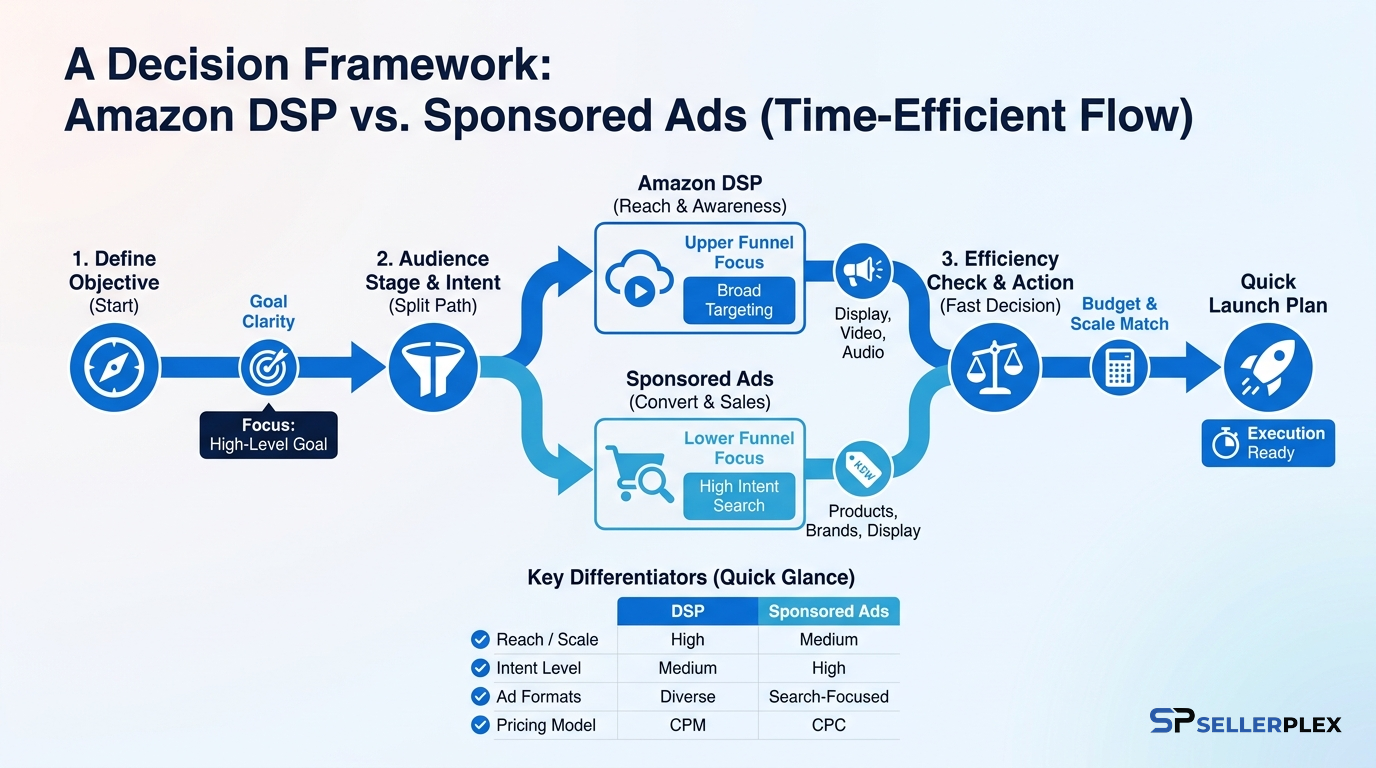
Skip the “is DSP right for me” quiz copy. Three questions actually decide it.
1. Is your Sponsored Products account already efficient?
“Efficient” means a TACoS you’d be happy to hold long-term, your top SKUs aren’t capped by impression share, and you’re not still finding wasted spend every audit. If the answer is no, the highest-ROI move is fixing Sponsored Products, not adding DSP. We see this pattern constantly, brands chasing DSP while leaving 20 percent of their sponsored budget on wasteful auto-campaign search terms.
2. Do you have audiences that keywords can’t reach?
Past purchasers, lapsed customers, competitor buyers, lookalike audiences for premium products. If yes, DSP probably pays off. If your entire growth thesis is “more high-intent search clicks,” sponsored is still where the money should be.
3. Are you willing to commit 90 days and proper measurement?
DSP isn’t a 30-day experiment. The retargeting pools take weeks to build, and the brand-halo effect on organic sales takes a full purchase cycle to show up. If you can’t commit to a quarter and a clean incrementality test (geo holdouts or a structured on/off rotation), don’t start.
If you said yes to all three, DSP belongs in the mix. If you said no to any of them, fix that first.
How to actually layer them
The brands seeing 30+ percent year over year growth on Amazon ad-attributed revenue aren’t running these as separate programs. The structure looks more like this:
- Sponsored Products carries the majority of the budget and drives keyword-level revenue and organic rank.
- Sponsored Brands defends branded SERPs and showcases the product family on high-volume category terms.
- Sponsored Display picks up off-Amazon retargeting and competitor ASIN targeting at CPC efficiency.
- DSP adds the audiences sponsored can’t reach: lapsed buyers at scale, cross-sell to your customer file, top-of-funnel video for higher-AOV SKUs, and competitor conquesting at the audience level rather than the ASIN level.
There’s also a less obvious benefit when you run them together. Amazon’s reporting shows that pairing sponsored with DSP lifts conversion rates on the sponsored campaigns themselves, shoppers who’ve seen a DSP impression are noticeably more likely to convert when they later click a sponsored ad. You can read Amazon’s own framing of this in the Amazon Ads measurement docs (the figures shift each year, but the directional effect has been consistent).
For a deeper view on how DSP fits into a brand’s ad architecture, our complete DSP advertising guide for 2026 goes deeper into audience strategy, creative requirements, and reporting setup.
Common traps to avoid
A few specific failure modes worth naming, because we see them every month.
Treating DSP attribution as gospel. DSP’s default attribution window is 14 days post-view, as documented in Amazon Ads’ attribution overview. That means any DSP impression a shopper saw in the last two weeks gets credit for the sale, including the ones they would have made anyway. Without a holdout test you cannot trust the headline ROAS number on the dashboard.
Letting sponsored auto campaigns drift. If you’re seriously considering DSP but your auto campaigns haven’t been mined for negatives in 60 days, you’re spending DSP money on a sponsored problem. The same operational discipline matters across both. Our breakdown of how scaling brands actually structure PPC covers the campaign hygiene side.
Hiring an agency that only does one. Sponsored-only agencies will tell you DSP is overhyped. The DSP-only shops will tell you sponsored is solved and the next dollar belongs with them. Neither view is right. The integration is the work.
Creative neglect. DSP banners and videos die from the same boring lifestyle photography that everyone else is running. The creative bar on DSP is closer to social ads than to Amazon listing images. If you wouldn’t pay to watch the video on Instagram, don’t expect it to convert on Fire TV.
If you want help with this
If you’re running enough Amazon ad spend that the DSP question is on the table, the highest-leverage move is usually an audit of how the sponsored side is actually performing, then a clean decision on whether DSP joins the mix. Our team manages both formats day to day across seven and eight figure brands, and the integration of the two is where most of the margin recovery shows up. You can see how we structure that work on our Amazon PPC and DSP management page, or book an audit and we’ll show you exactly where your current setup is leaking.
Frequently Asked Questions
Can I run Amazon DSP if I sell through Seller Central instead of Vendor Central?
Yes. DSP is available to both Seller Central and Vendor Central advertisers. It used to skew heavily Vendor, but Amazon opened DSP to most brand-registered sellers years ago. The bigger gating factor today is budget, not account type.
What’s the actual minimum spend to run Amazon DSP?
Self-serve DSP technically has lower thresholds, but realistically you want $10,000 to $15,000 per month in media to generate enough audience data and statistical signal to optimize. Below that you’re paying for the platform without getting the platform’s main advantage.
Is Sponsored Display the same thing as DSP?
No, although they overlap. Sponsored Display is bought CPC inside the regular ad console with no minimum spend and a narrower set of audiences and placements. DSP is bought CPM, supports far richer audience targeting (including past purchasers and lookalikes), and reaches off-Amazon inventory like Fire TV, Twitch, and the open web. For most brands under $5M revenue, Sponsored Display covers the use cases worth covering.
Will DSP cannibalize my organic or sponsored sales?
Some overlap is unavoidable, which is why incrementality testing matters. The cleanest method is a geo holdout: turn DSP off in matched regions for 30 days and measure the delta in total sales, not just attributed sales. If the dashboard says 4x ROAS but the holdout shows zero incremental lift, you have a cannibalization problem to fix.
Do I need different creative for DSP than for sponsored ads?
Yes. Sponsored creative leans on the listing image and a short headline. DSP requires designed banner sets across multiple sizes and ideally a 15 or 30 second video. Underinvesting in creative is the single most common reason DSP underperforms for brands that otherwise have the budget and audience strategy right.
Ready to Grow Your Amazon Business?
Book a free strategy session with our Amazon and e-commerce specialists. No obligations, just actionable insights.
Programmatic display and video that reaches shoppers on and off Amazon, layered on top of profitable search campaigns.
Want more of this in your Google results? Add SellerPlex as a preferred source.